

Currently Empty: € 0,00
AI
AI Readiness: 6 Critical Decisions for Mid-Size Firms

AI Readiness: 6 Critical Decisions for Mid-Size Firms
By Centralink
AI readiness is the ability to introduce a defined AI use with suitable information, people, operating controls, and resources. Centralink supports management and digital transformation in the Netherlands. This guide helps mid-size firms turn a readiness review into a clear investment decision.
What should an AI readiness review establish?
An AI readiness review should establish whether a specific proposed use has a credible purpose, workable conditions, and evidence supporting the next commitment. It should identify gaps and uncertainties rather than award a broad label. A firm can be ready for a bounded pilot while remaining unprepared for wider deployment.
Begin with a real workflow and the people affected. Record what should improve, what must remain dependable, and which decisions the system will influence. The review needs to cover business ownership as well as technical feasibility.
The approach below is Centralink’s suggested management structure. It is not a validated maturity instrument, and its six decisions should not be converted into a universal readiness percentage.
1. Is the business problem clear enough?
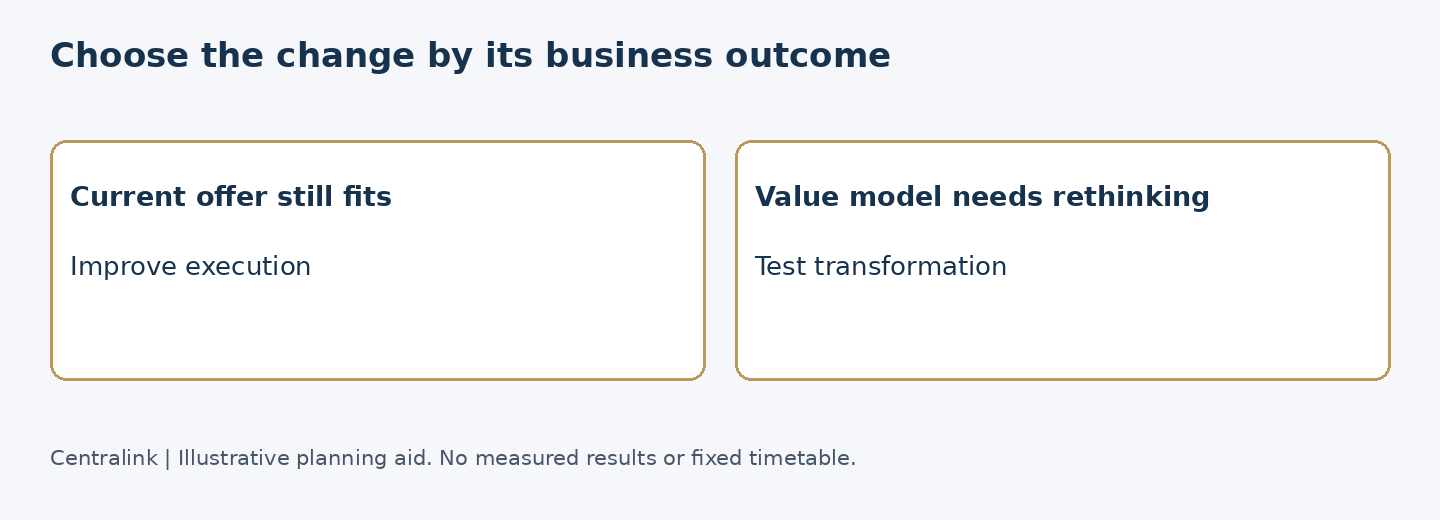
A useful AI readiness review starts with an observable problem, its present cost or service effect, and a defined desired outcome. A general ambition to become AI-first is too broad to evaluate. The proposal should explain why this workflow deserves attention and what alternatives have been considered.
Measure the current situation using a suitable sample of work. Record delays, errors, rework, demand, and customer or staff effects where relevant. Distinguish a verified baseline from an estimate. A target without a dependable baseline is difficult to interpret.
An illustrative finance team might want to reduce the time spent preparing internal reports. It should first separate collecting data, checking it, drafting commentary, and approving the report. The most valuable intervention may differ at each step.
2. Are data and workflow dependencies understood?
Readiness depends on the information and handovers required by the use, not only access to an AI application. Identify source quality, permissions, update responsibilities, and exceptions. A tool can produce a usable draft in a test while depending on manual work that makes normal operation expensive or unreliable.
Trace several ordinary and difficult cases through the process. Note which records staff consult, which judgements they make, and which inconsistencies they resolve informally. Those actions may be essential even if they are absent from the process description.
For further detail, use our digital foundations for AI guide. Do not assume a large technology replacement is necessary before examining the actual dependencies.
3. Can people perform their changed responsibilities?
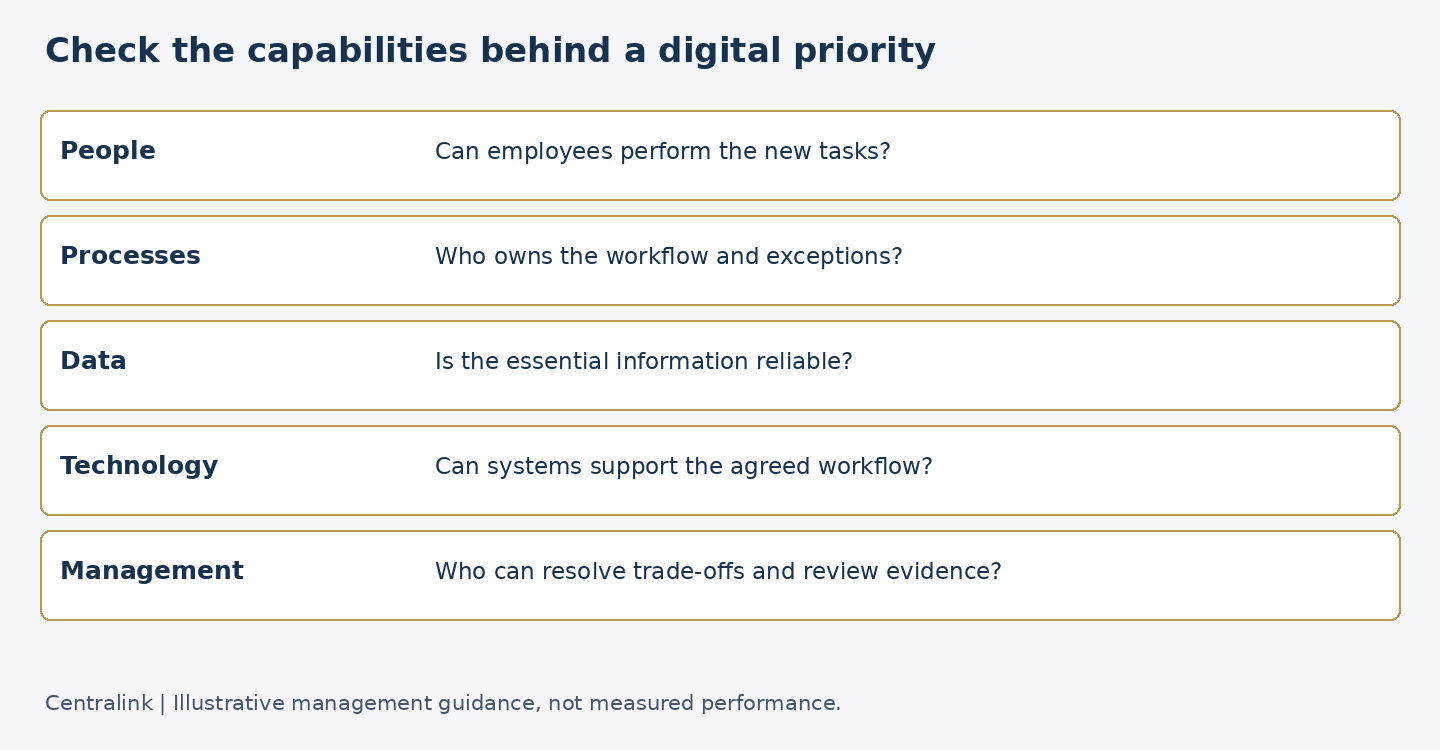
People readiness concerns the skills, authority, time, and support needed for the proposed way of working. Training should address real tasks and review decisions. A person’s confidence or course attendance does not establish that they can detect an error, challenge an output, or handle a difficult case.
Define what users, managers, and specialists will do differently. Practise those tasks with suitable examples, including uncertainty. Check whether an expected human review is realistic given the workload and the information available to the reviewer.
Involve staff in the design discussion. They may identify errors, extra work, or service exceptions that a demonstration misses. Use the feedback to improve the process and learning plan rather than treating every concern as an attitude problem.
4. Are oversight and decision rights workable?
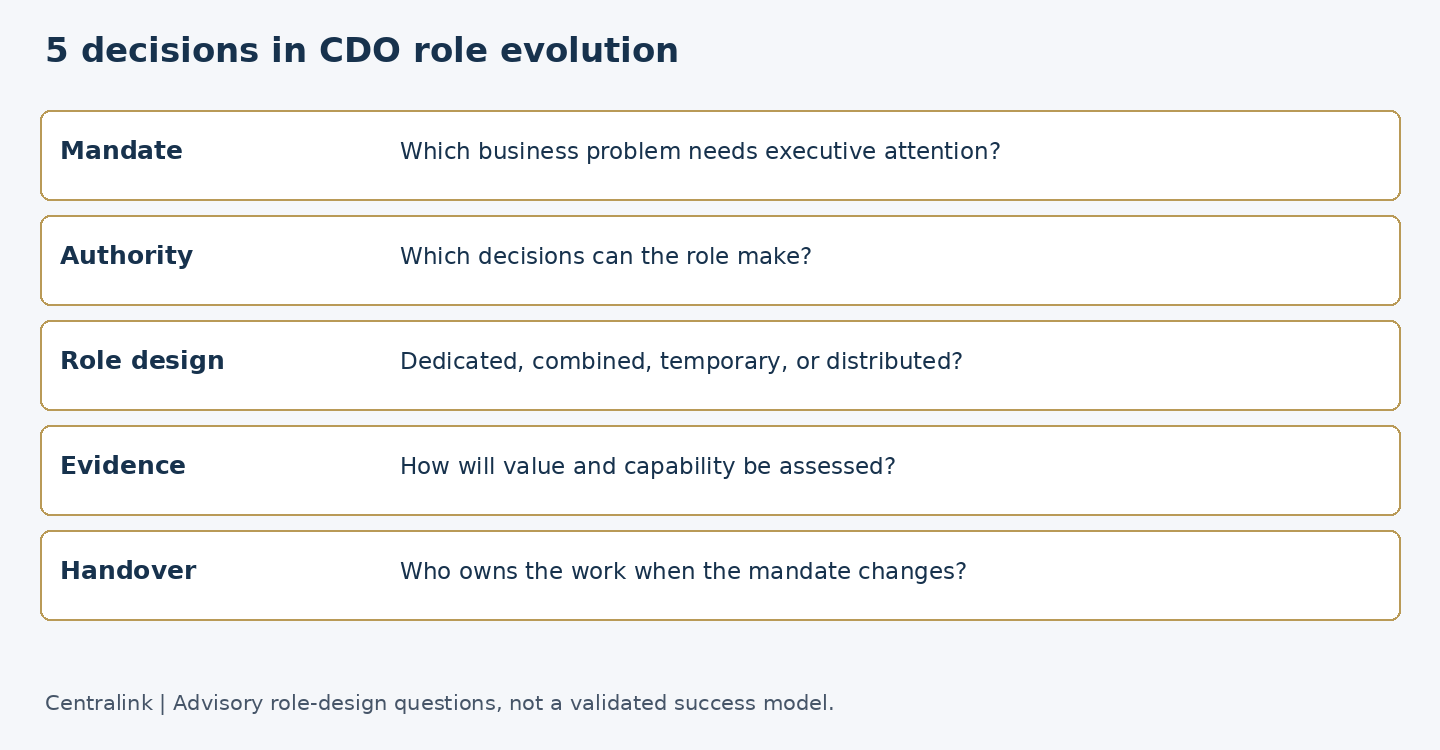
AI readiness requires clear decisions about approval, acceptable use, escalation, and stopping. A named business owner should understand the outcome and its consequences. Technical, privacy, security, legal, and HR specialists should be involved according to the use, without leaving the overall business decision unowned.
Record who can change the scope, accept a limitation, approve expansion, and suspend operation. Define the conditions requiring a new review when the supplier, data, purpose, or level of automation changes.
Connect the review with AI governance controls. General management preparation should not be presented as a legal classification or a declaration that a system complies with every applicable rule.
5. Is there a credible operating and financial case?
A readiness decision should include the total work and cost needed to operate the service, not only the software licence. Consider integration, evaluation, review time, training, support, maintenance, and possible interruption. Benefits should be linked to a business outcome that can actually be realised.
Time saved is not automatically cash saved. Explain whether the capacity will reduce delay, serve more demand, improve quality, or avoid an otherwise necessary cost. Show the assumptions, uncertainties, and circumstances under which the proposal would no longer make sense.
For a mid-size firm, dependencies between departments deserve particular attention. A saving in one team can create extra checking elsewhere. Ask the operating owners to review the complete case rather than accepting a local efficiency estimate.
6. Does the pilot answer the next decision?
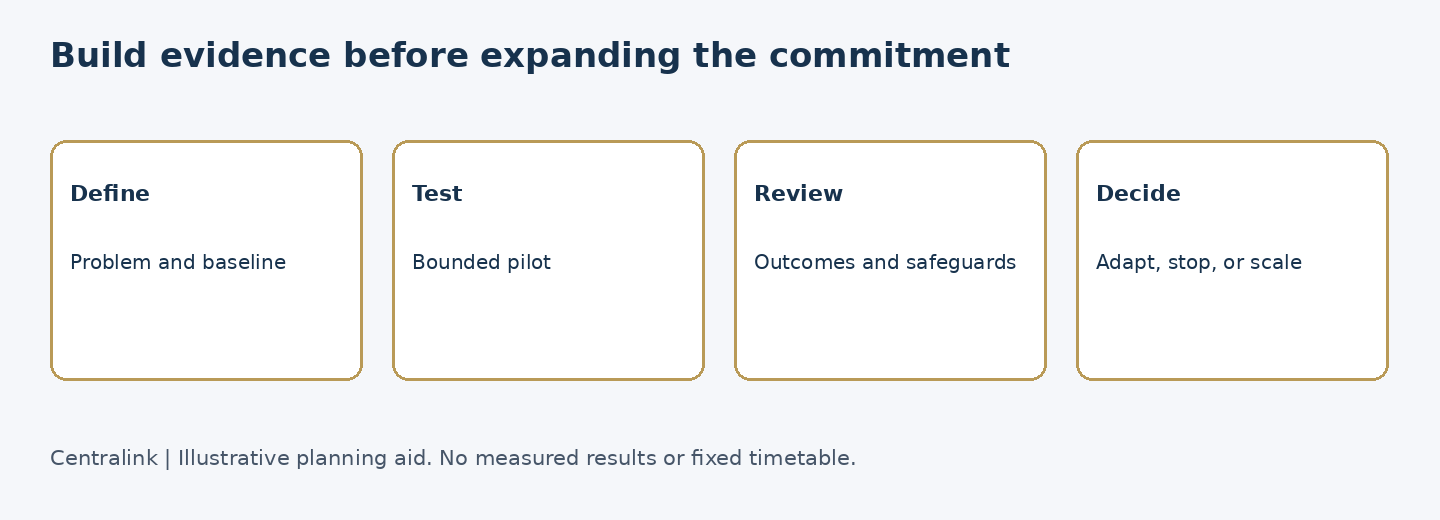
A pilot is useful when it tests a defined uncertainty and produces evidence for a decision. Specify its scope, participants, test cases, acceptance criteria, safeguards, and review date. A demonstration that produces an impressive example is not enough to justify routine use across the business.
Compare performance with the baseline. Include quality, serious errors, correction effort, user support, operating cost, and the limits of the sample. The next decision may be to expand, adapt, test again, restrict the use, or stop.
In the reporting example, the pilot could compare complete report preparation and approval, including factual corrections. If drafting is faster but verification takes longer, the result should remain visible. This is an illustrative evaluation scenario, not a reported client outcome.
An AI readiness decision record
Use this record to separate what is known from what still needs evidence. Each unresolved condition needs an owner and a review point. The record should support a decision rather than compress important differences into one overall score.
| Decision area | Evidence | Possible condition |
|---|---|---|
| Purpose | Baseline and outcome | Clarify before spending |
| Dependencies | Sources and process cases | Fix or exclude a gap |
| People | Observed task performance | Provide practice and support |
| Oversight | Owners and escalation | Assign authority |
| Economics | Total cost and benefit assumptions | Revise the case |
| Pilot | Test results and limitations | Expand, adapt, or stop |
Evidence and further reading
The OECD’s SME AI adoption paper links adoption pathways with digital maturity, use complexity, and scope. The NIST AI Risk Management Framework provides voluntary guidance for identifying and managing AI risks across the lifecycle. The CIPD Technology and People framework addresses the workforce implications of technology. Together these support a review that considers operating conditions as well as the application.
How can Centralink help?
Centralink can help leaders organise an evidence-based discussion of AI readiness, identify the dependencies of a proposed use, and define a practical next step. Start with a concrete business problem and the information needed to decide whether a pilot is justified.
Learn more about Centralink, explore our digital transformation services, or contact Centralink to discuss your organisation’s priorities.
Frequently asked questions
These answers clarify the decisions covered in this guide. Adapt the suggested approach to the organisation’s actual work, people, information, and resources. Examples are illustrative management scenarios rather than reported Centralink client results, and the guidance does not certify a system or establish legal compliance.
Can a company be ready for a pilot but not for scale?
Yes. A pilot can rely on limited users, manual support, or a narrow range of cases. Wider deployment may require different capacity, controls, and evidence. Record those limitations explicitly before treating the pilot result as a basis for expansion.
Should AI readiness be reported as one score?
A score can organise discussion only if its method and limitations are clear. Important weaknesses can be hidden by an average. For an investment decision, retain the evidence and unresolved conditions for each use rather than relying solely on a combined number.
Who should own the AI readiness review?
A business sponsor should own the decision and intended outcome, with input from operating teams and relevant specialists. HR, IT, risk, security, privacy, and legal responsibilities depend on the use. The review should name who can resolve gaps and approve the next commitment.