

Currently Empty: € 0,00
AI
AI Accountability: 5 Critical Questions About Responsibility

AI Accountability: 5 Critical Questions About Responsibility
By Centralink
AI accountability connects decisions and outcomes with people who have defined responsibilities, authority, and evidence. Centralink supports management and digital transformation in the Netherlands. This guide helps leaders examine who can approve a use, explain its operation, resolve problems, and accept the next commitment.
What does AI accountability mean in practice?
AI accountability means that the organisation can identify who is responsible for particular decisions and how those decisions can be examined and challenged. It requires more than naming an AI owner. People need authority, competence, information, and capacity that match the responsibilities assigned to them.
Separate operating accountability from a legal determination of liability. Contracts, regulation, employment responsibilities, and particular facts can affect legal questions. This guide concerns management arrangements and should not be treated as legal advice about an incident.
1. Who owns the business outcome?
Name the person responsible for the service or process the AI use is intended to improve. That person should understand the outcome, affected people, operating constraints, and accepted limitations. They need authority to resolve trade-offs or a clear route to someone who can.
A supplier or technical project manager may contribute important expertise without owning every business consequence. Use the AI business ownership guide to clarify the operating role.
2. Who can approve or change the scope?
AI accountability should identify who can approve information use, permissions, automation, and expansion. A system initially approved for drafting can create different consequences when connected to action tools. Scope changes need a decision rather than an assumption that the original approval covers everything.
Record the purpose, conditions, exclusions, and review triggers. Where a decision requires technical or specialist input, identify that contribution and the person authorised to make the final commitment.
3. Who can explain the evidence?
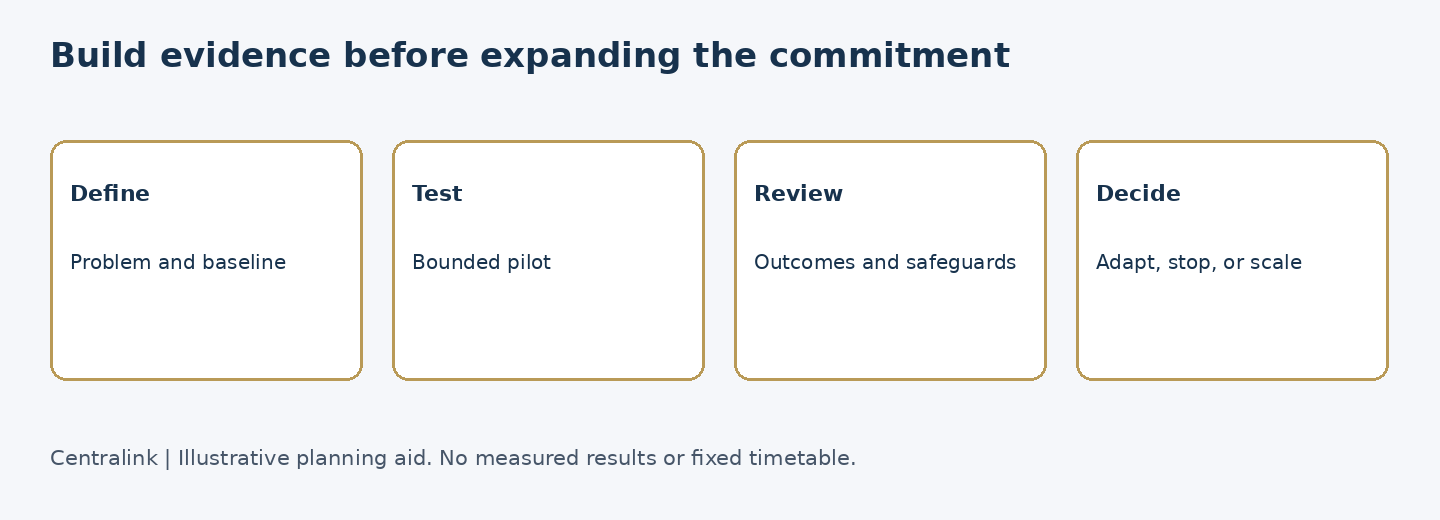
A responsible owner should be able to trace an important decision to the evidence available, its limitations, and the assumptions accepted. This does not require pretending that every model output has a complete explanation. It requires honest documentation of what the organisation knows and what remains uncertain.
Retain suitable approval, evaluation, and review records with appropriate information protection. A claim that the system or supplier decided is not a substitute for explaining the organisation’s own use and oversight.
4. Who responds when something goes wrong?
AI accountability needs a practical response route for errors, complaints, incidents, and unexpected effects. Identify who receives the issue, assesses the consequence, authorises restrictions, and communicates through the appropriate channels. The response may need several specialists, but the coordination should have an owner.
Use a controlled exercise or suitable past case to test the route. Check whether the authorised person can stop or limit the service and arrange recovery. Record unresolved gaps before relying on the process.
5. Who checks that responsibility stays current?
Responsibilities can become unclear when staff change, suppliers update services, or the use expands. Assign ownership of the responsibility record and review it when material conditions change. Delegation should clarify what is transferred, what authority accompanies it, and which oversight remains.
Connect the record with our AI governance review. A role chart is useful only when the named people understand and can fulfil their responsibilities.
Evidence and further reading
The OECD AI Principles include accountability across AI actors’ roles. The NIST AI RMF provides voluntary guidance for organisational governance. The CIPD’s AI guidance highlights cooperation where people are affected. These references inform management questions; they do not determine legal liability in a particular case.
How can Centralink help?
Centralink can help map decisions, authority, operating responsibilities, and evidence for an actual AI use. Begin with one decision where several teams currently assume another party is responsible.
Learn more about Centralink, explore our digital transformation services, or contact Centralink to discuss your organisation’s priorities.
Frequently asked questions
These answers clarify the decisions covered in this guide. Adapt the suggested approach to the organisation’s actual work, people, information, and resources. Examples are illustrative management scenarios rather than reported Centralink client results, and the guidance does not certify a system or establish legal compliance.
Can accountability be assigned to the AI system?
A system can perform functions, but management still needs to identify the people and organisations responsible for its development, deployment, and use. The allocation depends on actual roles and authority. Legal liability requires its own fact-specific assessment.
Does outsourcing AI remove internal responsibility?
It changes the division of work but does not eliminate the organisation’s need to understand its purpose, information, operating process, and decisions. Review supplier commitments and internal responsibilities together. Obtain specialist advice where required.
Is a named owner enough?
No. The owner needs relevant authority, competence, information, resources, and a workable escalation route. Check whether they can fulfil the role in practice. A title alone does not establish effective accountability.