

Currently Empty: € 0,00
AI
AI Roadmap: 6 Practical Stages from Problem to Operation

AI Roadmap: 6 Practical Stages from Problem to Operation
By Centralink
An AI roadmap connects a business problem with the decisions, capabilities, evidence, and operating responsibilities needed to address it. Centralink supports management and digital transformation in the Netherlands. This guide explains six practical stages and the questions that should govern progress between them.
What should an AI roadmap contain?
An AI roadmap should show the intended outcome, scope, dependencies, owners, resources, evidence, and review decisions for an initiative. It is more useful as a plan for learning and commitment than as a fixed list of technology launches. Dates should reflect the work required and the uncertainty involved.
The six stages below are Centralink’s suggested management structure, not a universal maturity model. Some activities overlap or repeat. Adapt the sequence to the use and consequences rather than treating every stage as a mandatory waterfall.
1. Define the problem and the decision
Start with an observable business problem and the outcome that should improve. Identify affected people, the present baseline, and the alternatives worth comparing. An AI roadmap needs a reason for action beyond keeping pace with competitors or introducing a fashionable tool.
Name the sponsor and the next decision. Agree what discovery should establish and how much effort is proportionate. If the problem remains unclear, refine it before selecting a supplier.
2. Examine dependencies and readiness
Review the information, process, systems, people, permissions, and responsibilities on which the use depends. Distinguish established conditions from gaps and assumptions. The organisation can be ready for a bounded test while still needing preparation before routine operation.
Use realistic cases and trace the complete workflow. Our AI readiness guide explains how to connect the findings with a practical decision rather than an unsupported overall score.
3. Compare options and design the test
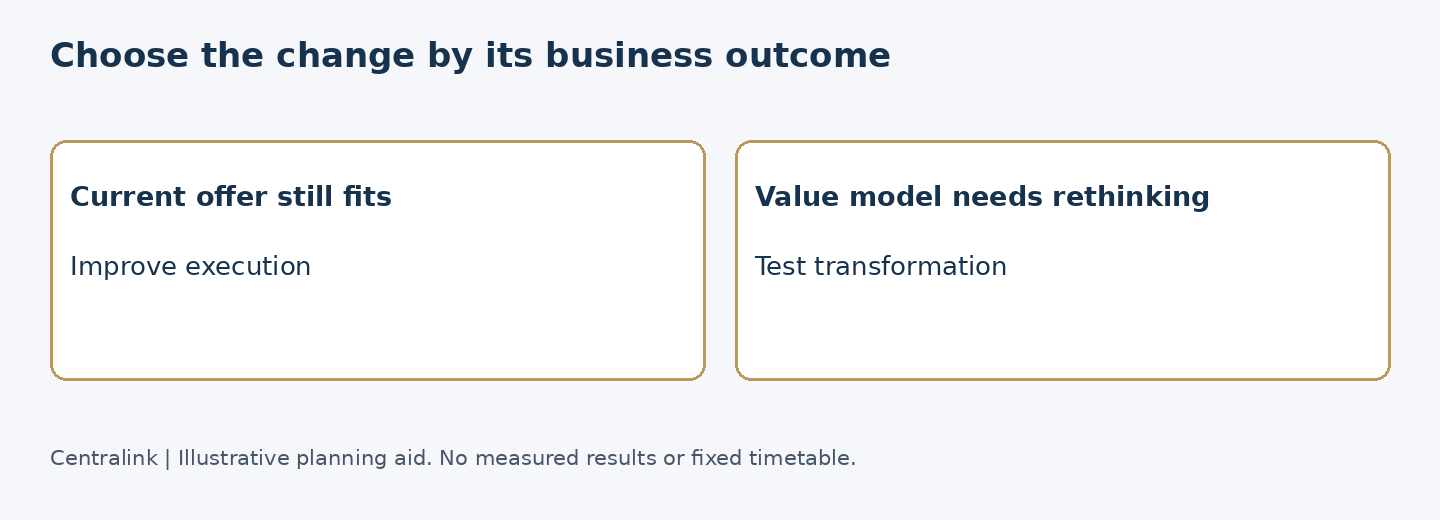
Compare a process improvement, an existing software feature, and an AI-enabled response using the same intended outcome. Where a pilot is justified, define its question, scope, users, cases, safeguards, and acceptance criteria. The test should address an uncertainty that matters to the next commitment.
Include total effort and cost, source quality, review capacity, support, and the consequences of errors. A supplier demonstration can inform the discussion but should not stand in for evaluation of the organisation’s own use.
4. Evaluate complete operating performance
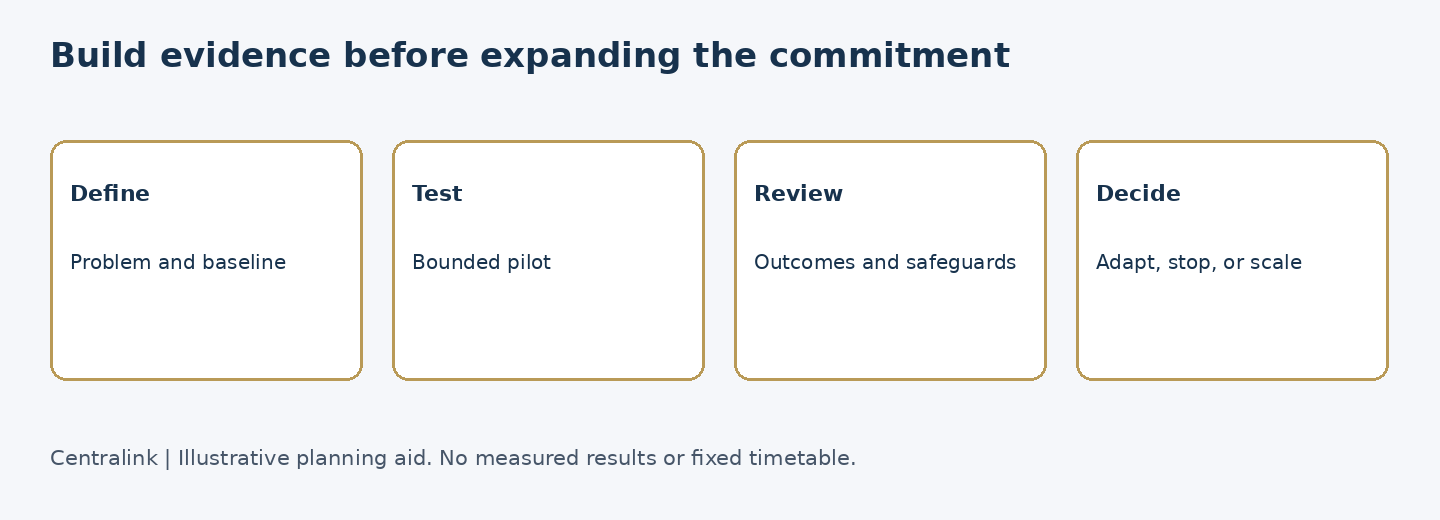
An AI roadmap should require evidence about the complete task, including checking, corrections, exceptions, and support. Compare results with the baseline and examine important failures separately from averages. Record the limits of the sample and what the pilot did not establish.
Use the findings to decide whether to expand, adapt, continue testing, restrict use, or stop. The decision should belong to an authorised owner with the relevant technical and specialist input.
5. Prepare ownership and handover
Before routine use, establish operating owners, instructions, learning, support, monitoring, incident response, and suitable recovery arrangements. A pilot can rely on attention or manual support that is not sustainable at normal demand. Make those dependencies explicit before accepting the service.
Use the AI project handover guide to connect the technical delivery with a receiving team able to run it. Record unresolved conditions and the limits of approval.
6. Review value, changes, and the next scope
An AI roadmap should continue beyond launch through evidence about quality, total effort, costs, service outcomes, and relevant effects on people. Review supplier changes, new uses, wider permissions, and altered information. Expansion should be a new decision supported by the next scope’s conditions.
Maintain a visible record of what changed, what was learned, and which decision follows. A useful roadmap can narrow or stop an initiative as well as expand it. Prior spending does not establish that continued investment is justified.
A roadmap decision worksheet
For each stage, record the evidence needed and the person authorised to decide. Keep assumptions visible and avoid treating a target date as proof of readiness. Expand the worksheet where the use and consequences require more detail.
| Stage | Main decision | Evidence |
|---|---|---|
| Define | Investigate this problem? | Baseline and outcome |
| Readiness | Suitable for a test? | Dependencies and gaps |
| Design | Approve this pilot? | Scope, safeguards and criteria |
| Evaluate | Proceed or change? | Results and limitations |
| Handover | Accept operating use? | Owners, support and recovery |
| Review | Continue or expand? | Value, changes and capacity |
Evidence and further reading
The OECD’s SME AI adoption paper identifies varied pathways and enabling conditions. The NIST AI RMF provides voluntary lifecycle risk-management guidance. The CIPD’s AI guidance connects implementation with people and operating design. The roadmap structure here is a management proposal rather than evidence that a fixed sequence guarantees success.
How can Centralink help?
Centralink can help connect an AI ambition with a practical problem, readiness review, pilot, and accountable operating plan. Begin with the next decision the organisation needs to make and the evidence that would support it.
Learn more about Centralink, explore our digital transformation services, or contact Centralink to discuss your organisation’s priorities.
Frequently asked questions
These answers clarify the decisions covered in this guide. Adapt the suggested approach to the organisation’s actual work, people, information, and resources. Examples are illustrative management scenarios rather than reported Centralink client results, and the guidance does not certify a system or establish legal compliance.
Is an AI roadmap just a project schedule?
No. A schedule shows planned timing, while a roadmap should also explain outcomes, dependencies, resources, owners, evidence, and decisions. Dates should be reviewed when important assumptions or conditions change.
Must every AI roadmap follow the same six stages?
No. The sequence is a practical planning structure that should be adapted to the use. Activities may overlap or repeat, and some decisions need more detailed review. Avoid forcing a fixed model where it obscures the actual work.
Should a roadmap promise a fixed return?
Only make claims supported by appropriate evidence and clear assumptions. Separate observed results from estimates and include complete costs and effort. A roadmap should expose uncertainty rather than hide it behind a guaranteed outcome.