

Currently Empty: € 0,00
Management
Digital Transformation Roadmap: 3 Critical Review Gates

Digital Transformation Roadmap: 3 Critical Review Gates
By Centralink
A digital transformation roadmap connects business outcomes with actions, dependencies, owners, and review decisions. This guide presents three practical review gates for planning and scaling change. Centralink supports management and digital transformation in the Netherlands.
Table of Contents
What should a digital transformation roadmap do?
A digital transformation roadmap should connect a business objective with the work, responsibilities, dependencies, and evidence needed to achieve it. It is more than a sequence of technology purchases. A useful roadmap shows the next decision and explains when further commitment is justified, while keeping current operations dependable.
Centralink supports management and digital transformation in the Netherlands. This article is a practical planning guide. For a separate strategic framework, read the three phases in the Digital Matrix.
The three review gates below are Centralink’s suggested planning approach. They are not a universal maturity model or a prescribed timetable. Adapt the detail and controls to the organisation’s scope, capacity, and consequences of failure.
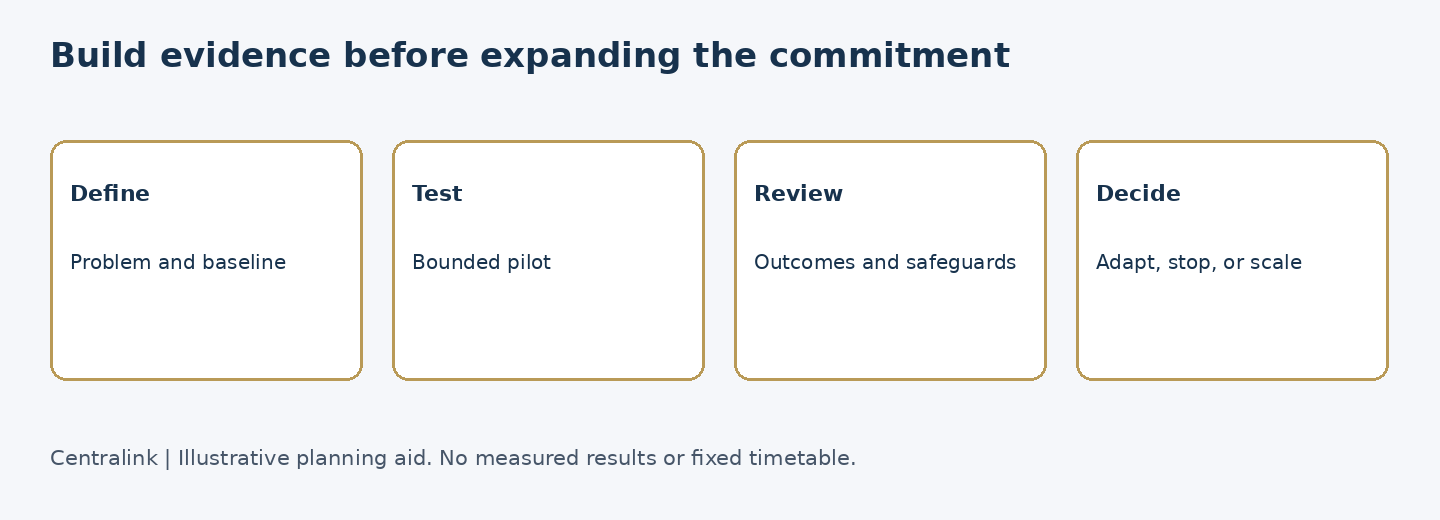
Gate 1: Is the problem and proposed value clear?
The first review gate checks whether the organisation understands the problem well enough to choose a sensible next step. It requires a defined customer or business outcome, a baseline, and explicit assumptions about the proposed change. A broad ambition to become digital is insufficient to guide an investment.
Map a real case from initial request to completion. Identify delays, repeated work, exceptions, and the information needed for decisions. Ask the people performing the work and the customers affected by it.
McKinsey’s transformation guidance emphasises starting with a business problem and developing the capabilities required to deliver value. Centralink’s application is to make that problem and the value assumptions reviewable before selecting the full solution.
| Evidence | What the review should establish |
|---|---|
| Problem definition | Who is affected and what needs to improve |
| Baseline | Current performance and how it was measured |
| Scope | What is included, excluded, and dependent on other work |
| Assumptions | What must be true for the proposal to make sense |
| Ownership | Who accepts the business outcome and next commitment |
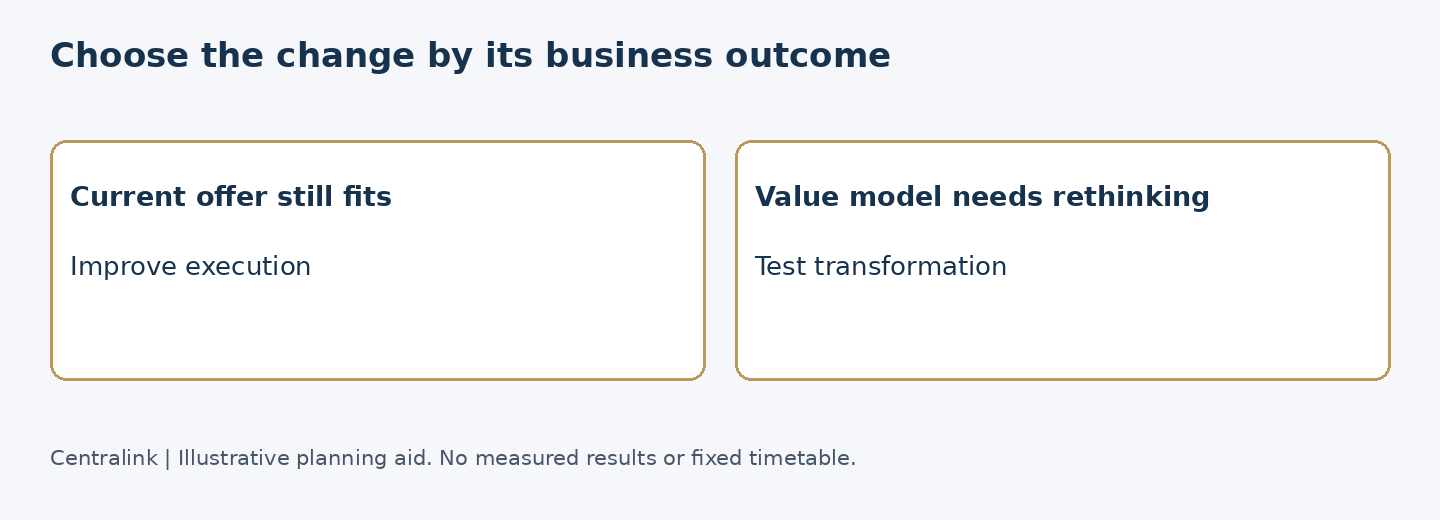
Gate 2: Can the proposed change work in practice?
The second review gate tests whether the proposed approach is useful, workable, and commercially or operationally credible within a defined scope. A prototype alone is insufficient. Include representative cases, realistic support effort, and the dependencies needed for normal use, then examine what remains uncertain before expanding.
Use a bounded pilot with an owner, acceptance criteria, safeguards, and a review date. Define the decisions it should inform. Record difficult cases and excluded situations rather than presenting a selected success as general proof.
MIT CISR’s 2026 digital innovation research describes staged evidence gathering around desirability, feasibility, and viability. This supports funding the next step when evidence warrants it rather than assuming the initial business case resolves every uncertainty.
| Test area | Useful evidence |
|---|---|
| Customer value | Observed usefulness and relevant demand |
| Process fit | Successful handling of routine and difficult cases |
| Information | Adequate quality, availability, and ownership |
| People | Ability to perform changed work with realistic support |
| Economics | Credible ongoing costs and benefit assumptions |
| Risk | Safeguards, monitoring, and recovery arrangements |
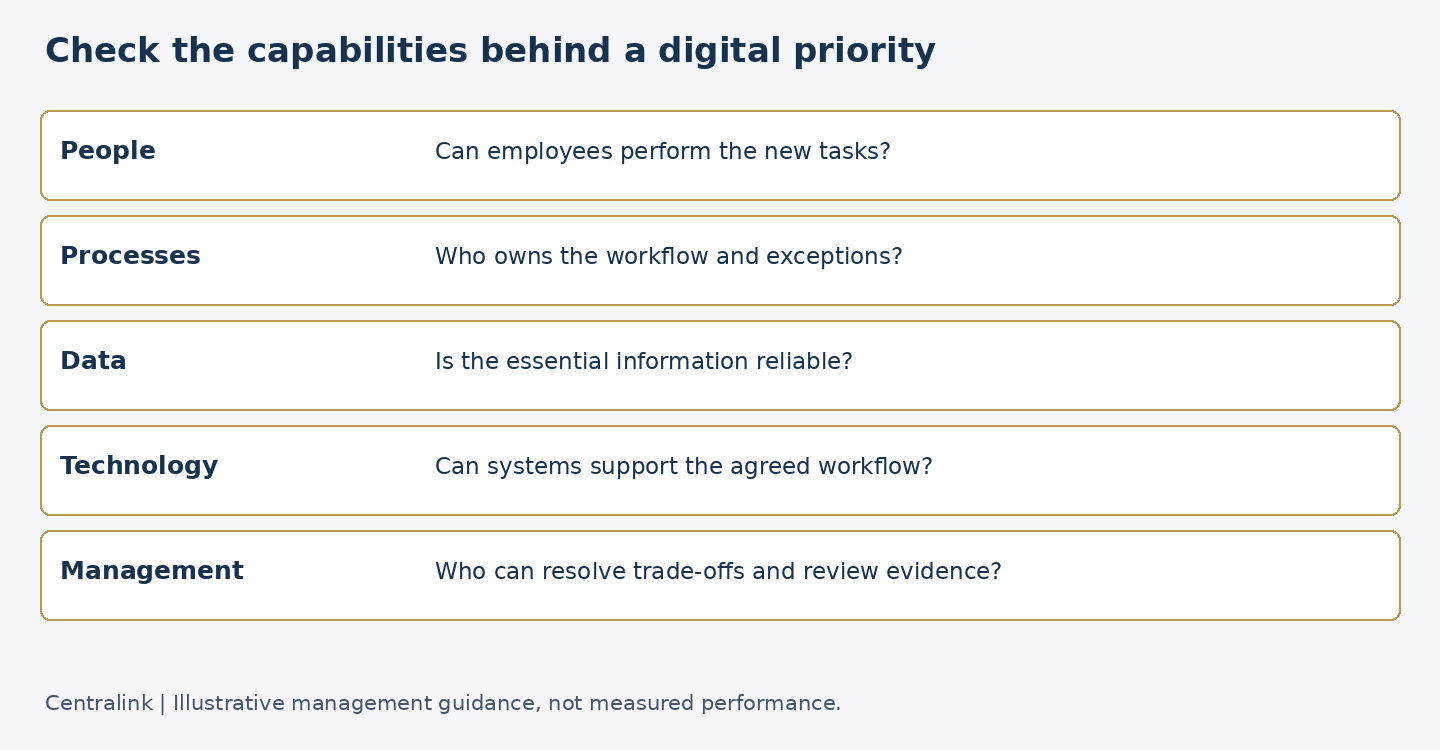
Gate 3: Can the organisation sustain and scale the change?
The third review gate examines whether a change can move into dependable operation or expand beyond its initial scope. It checks ownership, support, capacity, information quality, and business outcomes. Scaling should follow evidence from the intended operating conditions rather than the fact that the pilot has reached its scheduled end.
Name the service owner and agree how support, maintenance, training, supplier relationships, and performance reviews will work. Confirm that the team accepting the service has the authority and capacity required.
MIT CISR’s digital governance guidance explains the importance of decision rights and accountability. For a roadmap, this means making ownership clear at the point where project delivery becomes ongoing business responsibility.
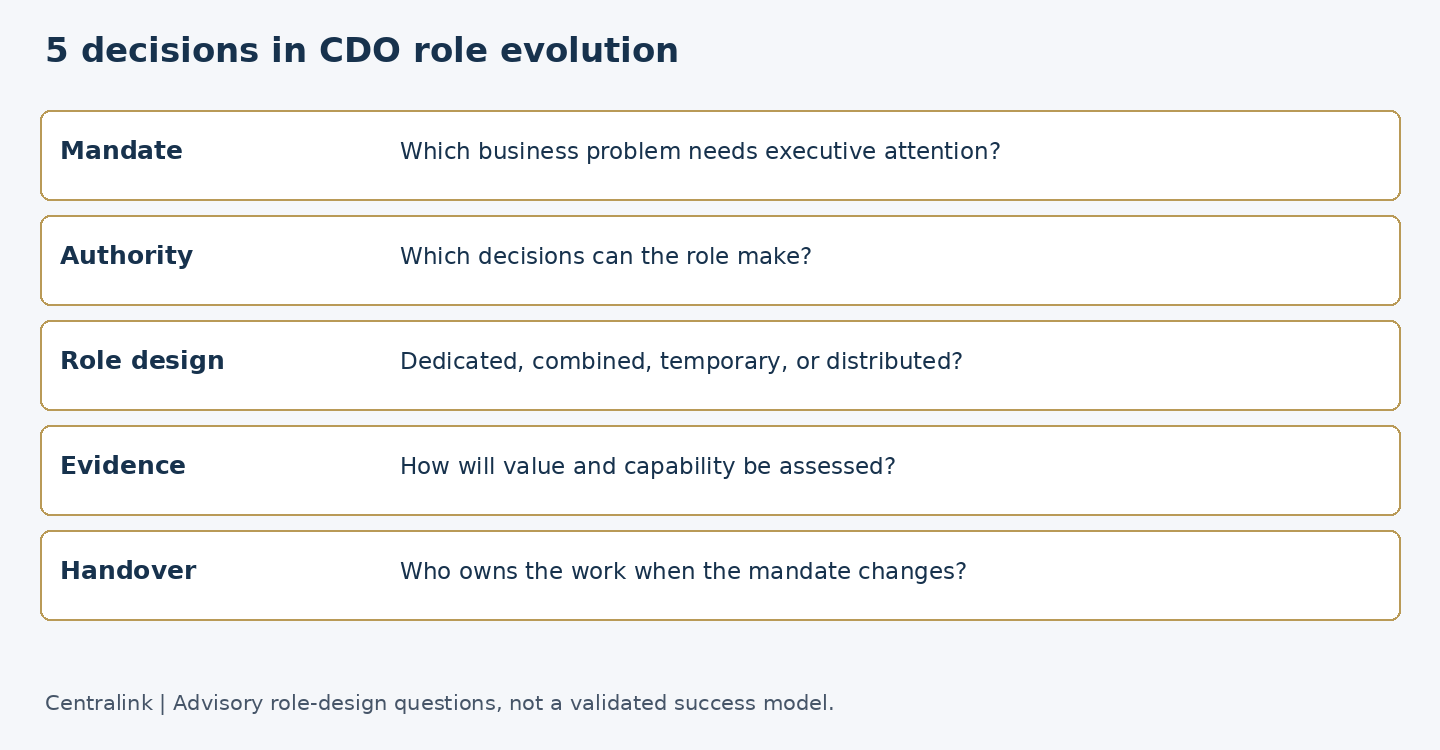
How should dependencies be shown?
Dependencies should show which people, decisions, information, systems, or supplier commitments must be available before another activity can proceed. A roadmap becomes misleading when it presents dates without these conditions. Identify the owner, required result, and consequence of delay for each dependency that could change the next decision.
Separate technical dependencies from business dependencies. A data connection may be technically ready while responsibility for correcting records remains unresolved. A training session may be delivered while managers have not allocated time for staff to practise.
Keep a short dependency register linked to the review gates. Escalate conflicts within a defined period and record decisions so that different teams do not continue using incompatible assumptions.
How should costs and capacity be planned?
Plan resources across diagnosis, testing, implementation, and operation rather than treating launch as the end of expenditure. Staff time and leadership attention are limited resources alongside money. A roadmap should identify the support and maintenance commitment created by each new capability before the organisation agrees to expand it.
Include data preparation, integration, training, supplier support, service monitoring, and exit arrangements. Distinguish a financial saving from capacity released for other work. Time saved does not automatically translate into cash returned to the business.
Use ranges where assumptions are uncertain. Review the impact of slower adoption, lower demand, higher support effort, or a delayed dependency. Make clear which uncertainty the next stage is intended to reduce.
A simple roadmap worksheet
A useful worksheet links the next business decision with evidence and ownership. It should be detailed enough to reveal assumptions and brief enough to maintain. The table below is an illustrative planning structure that a leadership team can adapt, rather than a complete project plan for every organisation.
| Roadmap field | What to specify |
|---|---|
| Outcome | The customer or business result to improve |
| Current position | Baseline and known limitations |
| Next change | The bounded work proposed |
| Owner | The person accountable for the next decision |
| Dependencies | Required information, resources, and approvals |
| Evidence | Acceptance criteria and measurement approach |
| Operating impact | Changes to roles, support, costs, and commitments |
| Review gate | Continue, adapt, expand, pause, or stop |
Use the worksheet to support discussion, not to manufacture certainty. Mark estimates and unknowns clearly. Revisit the roadmap when evidence changes a material assumption or dependency.
Illustrative example: improving order updates
A hypothetical business wants customers to receive more reliable order updates. The first gate examines the customer problem and the accuracy of current status information. The second tests a bounded update process with realistic cases. The third checks whether ownership and support can sustain the service across the intended customer group.
The sequence does not require a large portal project from the start. A simpler information or process change may resolve the problem. The roadmap should preserve that option until evidence justifies a larger commitment.
This is a planning example, not a reported Centralink client result. The timing, safeguards, and evidence needed depend on the actual process and customer commitments.
Which roadmap mistakes should leaders avoid?
Avoid a roadmap that treats activity as value, hides dependencies, assigns responsibility without authority, or expands work without reviewing evidence. A clear schedule can help coordinate delivery, but it cannot establish whether the proposed change remains useful or supportable. Review the assumptions behind milestones as well as the dates.
- Technology first: Choosing a platform before defining the outcome.
- Unowned dependencies: Assuming another team will resolve a critical issue.
- Pilot optimism: Ignoring support effort and excluded difficult cases.
- Launch as completion: Closing delivery without operating ownership.
- Automatic expansion: Treating the next stage as inevitable.
Read digital transformation myths for related planning and governance misconceptions.
A digital transformation roadmap should make the organisation’s next commitment easier to assess. Clear outcomes, bounded tests, and operating ownership help leaders connect ambition with practical decisions. The roadmap should change when evidence changes, while keeping responsibilities and the reason for each decision visible to the people doing the work.
Learn more about Centralink, explore our digital transformation services, or contact us to discuss your next step.
Frequently asked questions
These answers clarify the scope and practical use of this guide. Apply the guidance to your organisation’s circumstances, and check specialist requirements where the decision involves regulated activities, personal data, or significant contractual commitments. The examples in this article are illustrative rather than reported client results.
Is a roadmap the same as a strategy?
No. A strategy explains business choices and priorities, while a roadmap connects those choices with work, dependencies, ownership, and review points. The roadmap should follow the strategic direction. It may also reveal constraints or evidence that require leaders to reconsider an assumption.
Should a roadmap have fixed dates?
Some commitments and dependencies need firm dates, while uncertain work needs explicit assumptions and review points. Distinguish those situations rather than making every date equally certain. A date is useful for coordination but does not prove that acceptance criteria have been met.
When should an organisation stop a pilot?
Stop or redesign when evidence no longer supports the intended value, the safeguards are inadequate, or the next commitment exceeds the agreed capacity or authority. Define these conditions in advance where possible. Ending an unsuitable pilot can be a useful outcome of disciplined learning.