

Currently Empty: € 0,00
Management
Digital Adaptation Plan: 7 Critical Decisions

Digital Adaptation Plan: 7 Critical Decisions
By Centralink
A digital adaptation plan turns changing business conditions into explicit assumptions, options, tests, and decisions. This guide provides seven practical decisions and a one-page planning template. Centralink supports management and digital transformation in the Netherlands.
Table of Contents
What is a digital adaptation plan?
A digital adaptation plan connects a change in business conditions with the assumptions, tests, responsibilities, and resources needed for a response. It helps an organisation decide what to maintain, improve, or change. The plan should make uncertainty visible and guide a proportionate commitment rather than predict the future with false precision.
Centralink supports management and digital transformation in the Netherlands. This article is a practical planning companion to our digital adaptation guide. The seven decisions below are Centralink’s suggested working approach, not a validated assessment model.
Drucker’s Theory of the Business examines how organisational assumptions can lose their fit with reality. A practical adaptation plan turns that general concern into explicit questions about the organisation’s next decision.
1. Define the change that warrants attention
Start with an observed change and explain why it might matter to the business. Identify the customer group, process, offer, or relationship affected. Separate what has happened from an interpretation of its meaning, and record alternative explanations so the organisation can investigate before choosing a response.
A trigger might be a pattern of lost orders, changing support requests, a new supplier capability, or a persistent operating constraint. A technology announcement can be relevant, but it does not by itself establish a business need.
Record the source and date of the observation. Ask whether it represents a temporary event, a local issue, or a wider pattern.
2. Identify the assumption at risk
A useful plan names the belief that the observation may challenge. It could concern what customers value, how they buy, which capabilities create advantage, or how the business earns a return. An explicit assumption is easier to test than a broad claim that the organisation must modernise.
Write the assumption as a statement about a defined situation. Then identify evidence that would support or weaken it. Avoid statements so general that no result could challenge them.
The weak-signal perspective developed by Ansoff is relevant to early uncertainty. Centralink’s application is to investigate important signals without treating them as forecasts.
3. Compare several possible responses
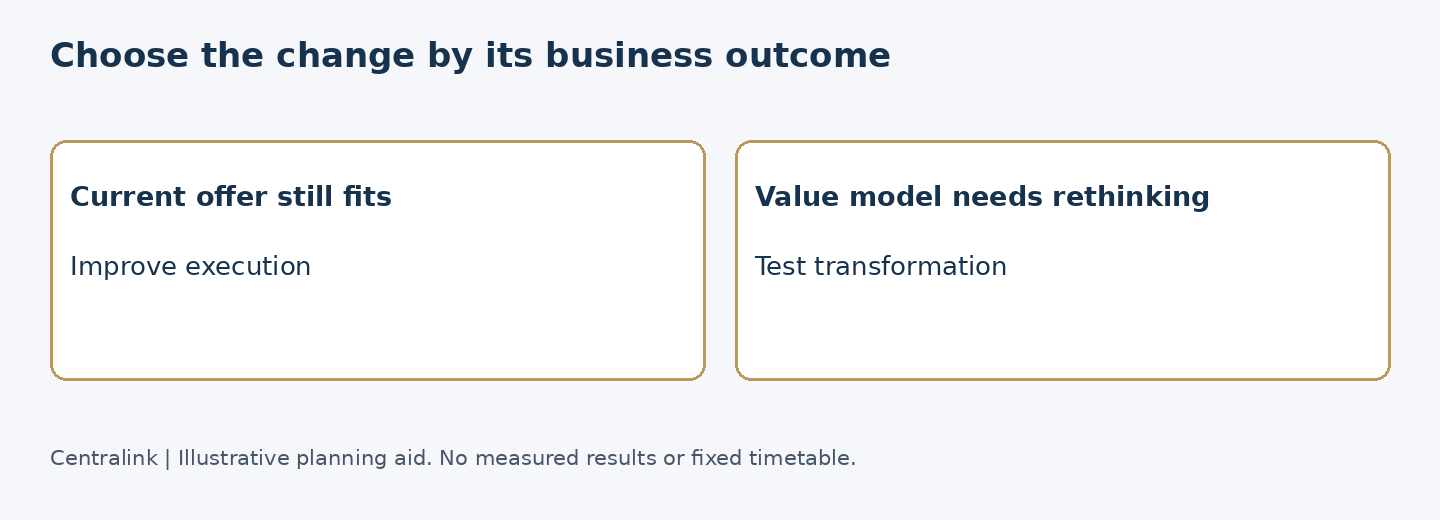
Compare maintaining the current approach, making a focused improvement, and testing a broader change. Each option has costs, uncertainties, and consequences. A plan should explain why the proposed response is preferable now, rather than presenting a new platform or operating model as the only available choice.
Include the cost of delay alongside the cost of acting. Also consider whether a reversible step can preserve useful options while producing evidence.
Use transformation versus improvement to discuss scope. The aim is to choose a response that fits the problem and the organisation’s capacity.
4. Balance current work and exploration
An adaptation plan needs resources for learning without allowing the current service to become unreliable. Specify the staff time, funding, and leadership attention available for the next step. Consider the combined effect of several initiatives, because individually modest commitments can compete for the same limited people.
March’s research on exploration and exploitation explains why resource allocation between new possibilities and established practices is difficult. It does not supply a universal budget percentage for an individual organisation.
Make the trade-off explicit: which work will wait, what service obligations remain protected, and who can approve a change in capacity?
5. Design a bounded test
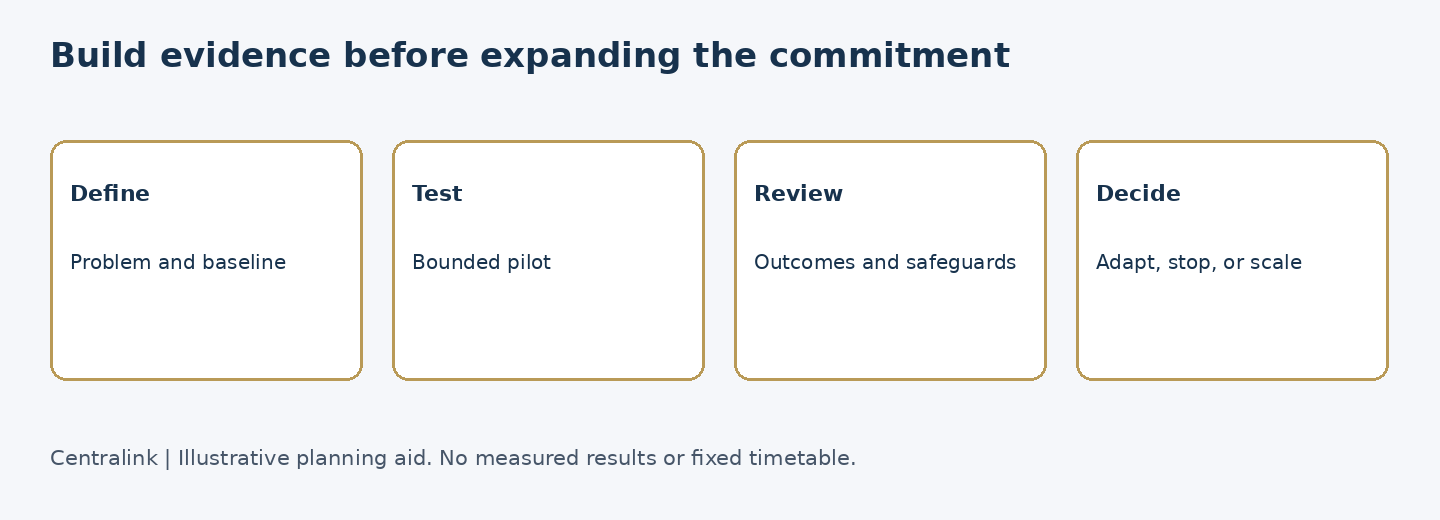
A bounded test investigates a specific assumption with a defined scope, owner, acceptance criteria, and end decision. It should produce evidence relevant to the next commitment while limiting unnecessary cost and exposure. A prototype is useful only when the organisation knows what question it is intended to answer.
Include representative cases, practical support effort, and relevant constraints. Record what the test excludes and which conclusions those exclusions prevent.
A test can establish that an option deserves further investigation without proving that it is ready for full operation. Keep those decisions separate.
6. Assign decision and operating responsibilities
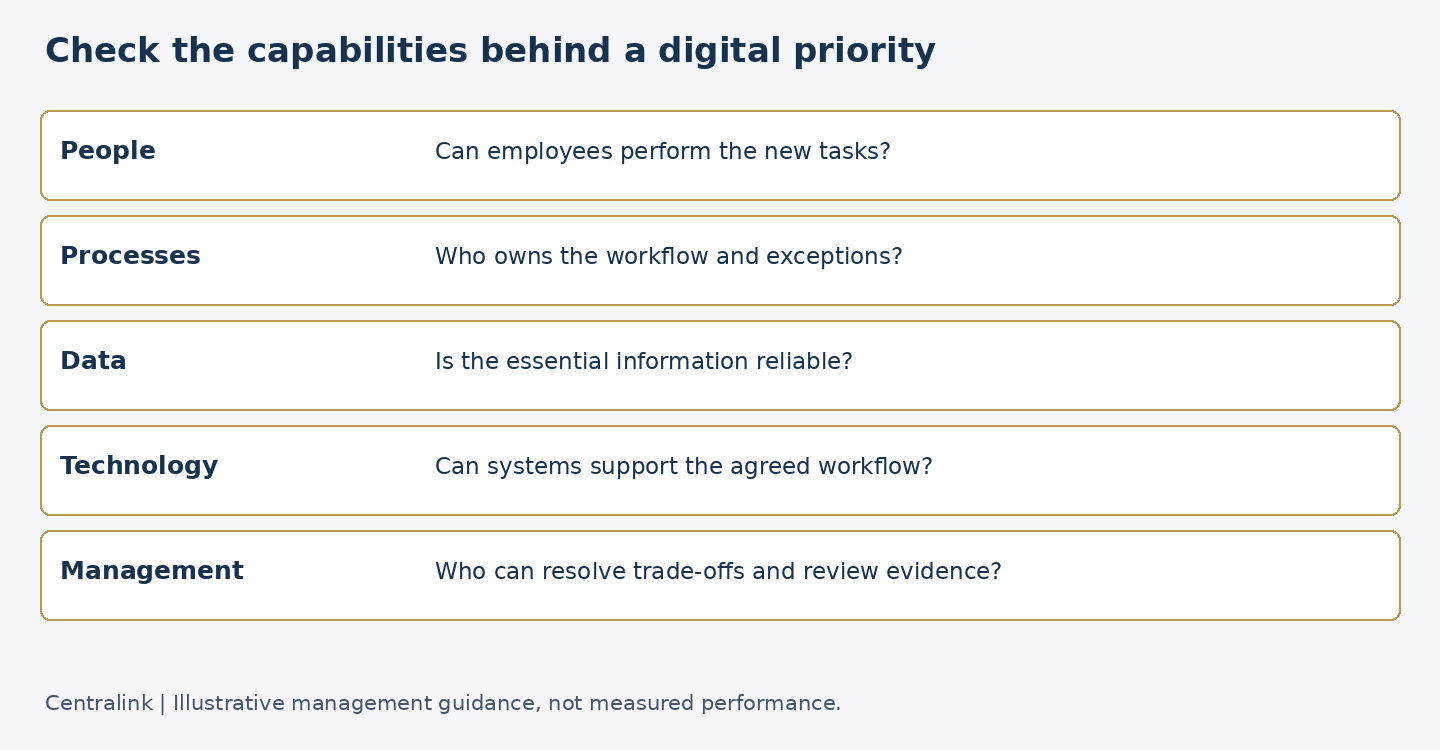
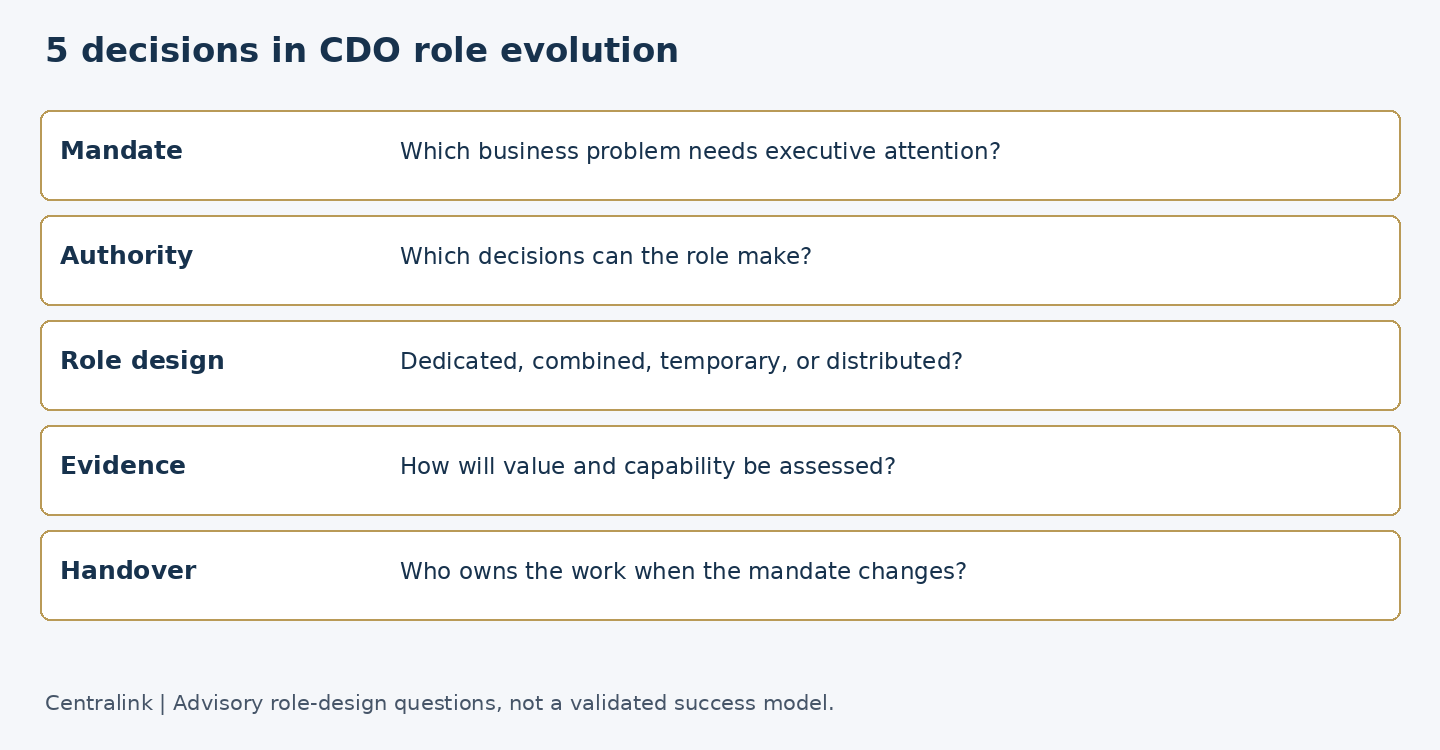
The plan should identify who can approve the next commitment and who will own the change if it becomes part of normal work. Suppliers and project teams can deliver defined tasks, but important business decisions still need accountable owners with suitable authority, capacity, and access to relevant evidence.
Clarify responsibility for customer commitments, information quality, staff preparation, service support, and exception handling. Where several teams are involved, name the person who resolves conflicting priorities.
Use digital transformation and leadership to review the executive responsibilities behind the plan.
7. Agree the review and next commitment
Agree in advance when the evidence will be reviewed and what decisions are available. Continue, adapt, expand, pause, and stop should all remain credible options. The review should compare results with the original assumption and examine the operating consequences rather than only reporting that planned activities were completed.
Document the result, its limits, and the reason for the decision. If the plan changes, explain which assumption or constraint changed.
When expansion is justified, update the resource and operating responsibilities before committing. The next phase should earn its support through evidence, not simply follow because the previous phase has ended.
A one-page digital adaptation plan
A one-page plan can support a focused discussion when it links the problem, assumption, response, and decision. Keep the fields specific enough to expose uncertainty. The template below is a suggested working structure and should be expanded where the consequences or dependencies require more detailed planning.
| Field | Content to agree |
|---|---|
| Observed change | Evidence, source, date, and affected group |
| Business assumption | What may no longer fit |
| Options | Maintain, improve, or change |
| Proposed test | Scope, owner, acceptance criteria, and exclusions |
| Resources | Funding, time, skills, and protected operating commitments |
| Responsibilities | Decision authority and future operating owner |
| Review | Date, evidence, and available decisions |
| Next commitment | What may be authorised if the evidence supports it |
Do not fill unknown fields with optimistic estimates merely to complete the document. Mark uncertainty and identify the least costly credible way to resolve the important gaps.
Illustrative example: testing a new service channel
A hypothetical business observes repeated requests for online support. Its plan should test whether those requests reflect a broader preference and whether an online channel improves the customer’s outcome. The plan should also examine information quality, employee workload, service accessibility, and the cost of maintaining the channel.
The bounded test might use a defined customer group and a small set of support tasks. Include difficult cases and retain a suitable alternative where the channel cannot meet the need.
This is an illustrative planning example, not a reported Centralink client result. The appropriate scope and safeguards depend on the actual service and customer commitments.
A digital adaptation plan is valuable when it makes the next decision clearer and more responsible. It should connect a meaningful observation with an explicit assumption, a proportionate test, and accountable action. A concise plan supported by evidence is more useful than a detailed document built on untested certainty.
For a related delivery structure, read our digital transformation roadmap. Learn more about Centralink or contact us to discuss your business priorities.
Frequently asked questions
These answers clarify the scope and practical use of this guide. Apply the guidance to your organisation’s circumstances, and check specialist requirements where the decision involves regulated activities, personal data, or significant contractual commitments. The examples in this article are illustrative rather than reported client results.
Does an adaptation plan need a long-term forecast?
It needs a clear direction and explicit assumptions, but not false precision about uncertain conditions. Distinguish firm commitments from hypotheses. Use review points to update the plan when evidence changes, while keeping current operating responsibilities and the next decision clear.
Who should own the plan?
A business owner with authority over the intended outcome should be accountable for the plan. Process, technology, finance, and people specialists may contribute. The owner needs enough capacity and access to decision makers to resolve trade-offs rather than merely collect updates.
What if the test does not support the proposal?
Review what the evidence establishes and whether a revised option is worth investigating. Stopping can protect resources when the assumptions no longer hold. Record the learning and the decision so that the organisation does not repeat the same unsupported proposal later.