

Currently Empty: € 0,00
AI
AI Use in Security Teams: 5 Critical Control Questions

AI Use in Security Teams: 5 Critical Control Questions
By Centralink
AI use in security teams needs clear approval, information boundaries, evaluation, and accountability, just as it does elsewhere in the business. Centralink supports management and digital transformation in the Netherlands. This guide helps leaders review professional use without assuming expertise removes operating risk.
Why should security teams review their own AI use?
Security professionals may use AI to summarise information, support analysis, or prepare documentation. Their expertise matters, but it does not make every service, input, or output suitable. The team’s access to sensitive material can make information handling and permission decisions particularly important.
Avoid assuming that security staff generally misuse AI. Examine actual uses and controls. A review should identify whether the operating arrangement is suitable, whether a task needs additional safeguards, and who can approve it.
1. Is the task and service explicitly approved?
Approval should cover the purpose, account, information, permissions, and expected output rather than a supplier name alone. A service approved for public information may be unsuitable for internal incident material. The operating owner should understand which uses fall within the decision.
Record the task and maintain a route for new requests. Where the tool changes or receives wider permissions, review whether the existing approval remains applicable. Specialist expertise should support that decision rather than substitute for it.
2. What information will leave the organisation?
Review whether the proposed use shares internal logs, customer information, vulnerabilities, credentials, or other restricted material with an external service. The actual sensitivity and service terms matter. Use appropriate security, privacy, contractual, and legal review before permitting the flow.
Use synthetic, public, or otherwise approved information for practice and initial evaluation where suitable. Do not assume that removing obvious names makes a record safe to disclose. Examine the whole information context.
3. How will outputs be evaluated?
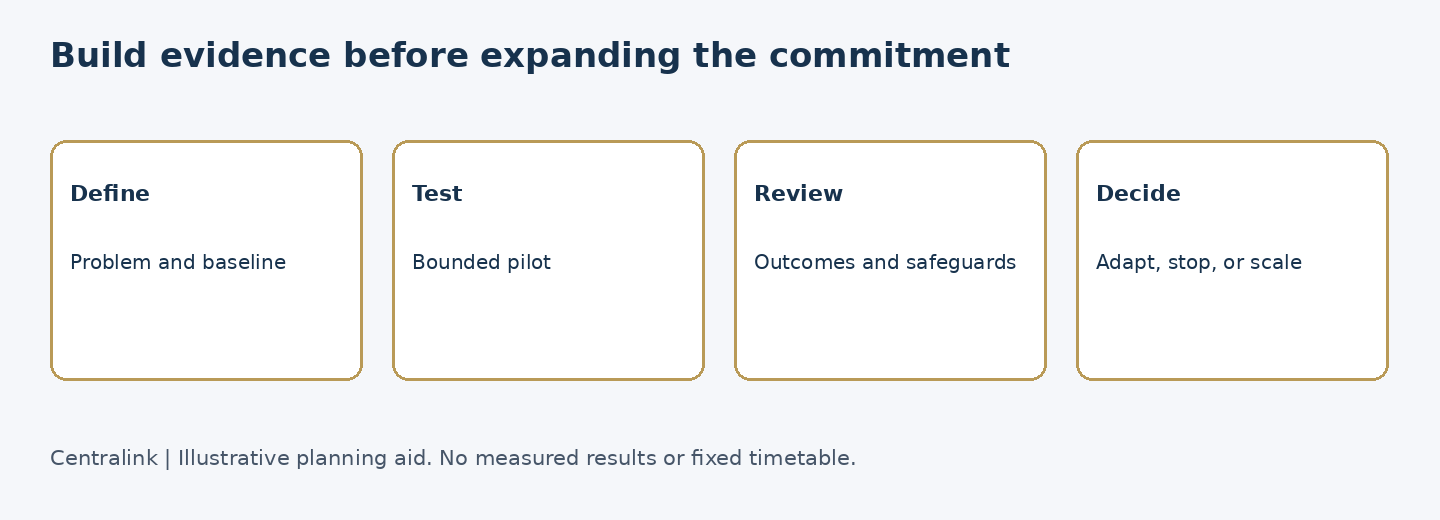
AI-assisted analysis can contain omissions, incorrect interpretations, or misleading confidence. A security team should define how it will compare important output with source evidence and existing procedures. The tool should not quietly become the authority for a consequential operational decision.
Test realistic cases, including incomplete information and plausible errors. Retain professional judgement and escalation routes. Assess the complete task and the effort needed to verify the result, not only the speed of generating an initial answer.
4. Which actions and permissions are allowed?
A tool that drafts a summary differs from an agent allowed to change configurations, contact third parties, or act across systems. Define the permitted actions and approval points, and restrict access to what the use needs. Accountable staff should be able to inspect and interrupt consequential activity.
For a management review, request a clear description of access and action boundaries. Avoid using a successful demonstration as evidence that broader autonomy is appropriate. See our AI agents guide.
5. Who owns monitoring and incident response?
AI use in security teams needs an owner for instructions, service changes, activity review, and problems. The team should apply its own approved governance and incident arrangements consistently. An informal exception can become difficult to assess if nobody records its purpose, limits, and review conditions.
Review lessons from errors and near misses without assuming every problem is individual carelessness. Update the workflow, evaluation, permissions, or learning plan where evidence shows a gap. Keep specialist accountability visible after the pilot ends.
Evidence and further reading
The NCSC’s Shadow IT guidance discusses unmanaged services and unmet user needs. NIST’s agent-security work highlights risks where AI outputs connect with software actions. Australian government agentic AI guidance addresses access, monitoring, and oversight. These references support reviewing the use; they do not establish a prevalence statistic for security-team misconduct.
How can Centralink help?
Centralink can help clarify the business purpose, approval responsibilities, and operating review for AI use. Technical security assessment and incident decisions should remain with suitably qualified professionals and the organisation’s authorised owners.
Learn more about Centralink, explore our digital transformation services, or contact Centralink to discuss your organisation’s priorities.
Frequently asked questions
These answers clarify the decisions covered in this guide. Adapt the suggested approach to the organisation’s actual work, people, information, and resources. Examples are illustrative management scenarios rather than reported Centralink client results, and the guidance does not certify a system or establish legal compliance.
Does security expertise make any AI service suitable?
No. Suitability depends on the task, information, service arrangement, access, and consequences. Expertise supports assessment but does not remove the need for an explicit decision and operating controls.
Should security teams be excluded from the AI policy?
Their work may need specific instructions, but exceptions should be explicit, authorised, and reviewed. A general exemption can hide important information and permission decisions. Apply proportionate controls to the actual use.
Can AI-assisted security analysis be used without checking?
The necessary review depends on the task and consequence. Important findings and operational actions need suitable evidence and authorised judgement. Define the review before relying on the output in routine operations.