

Currently Empty: € 0,00
Management
CDO Role Evolution: 5 Critical Leadership Decisions

CDO Role Evolution: 5 Critical Leadership Decisions
By Centralink
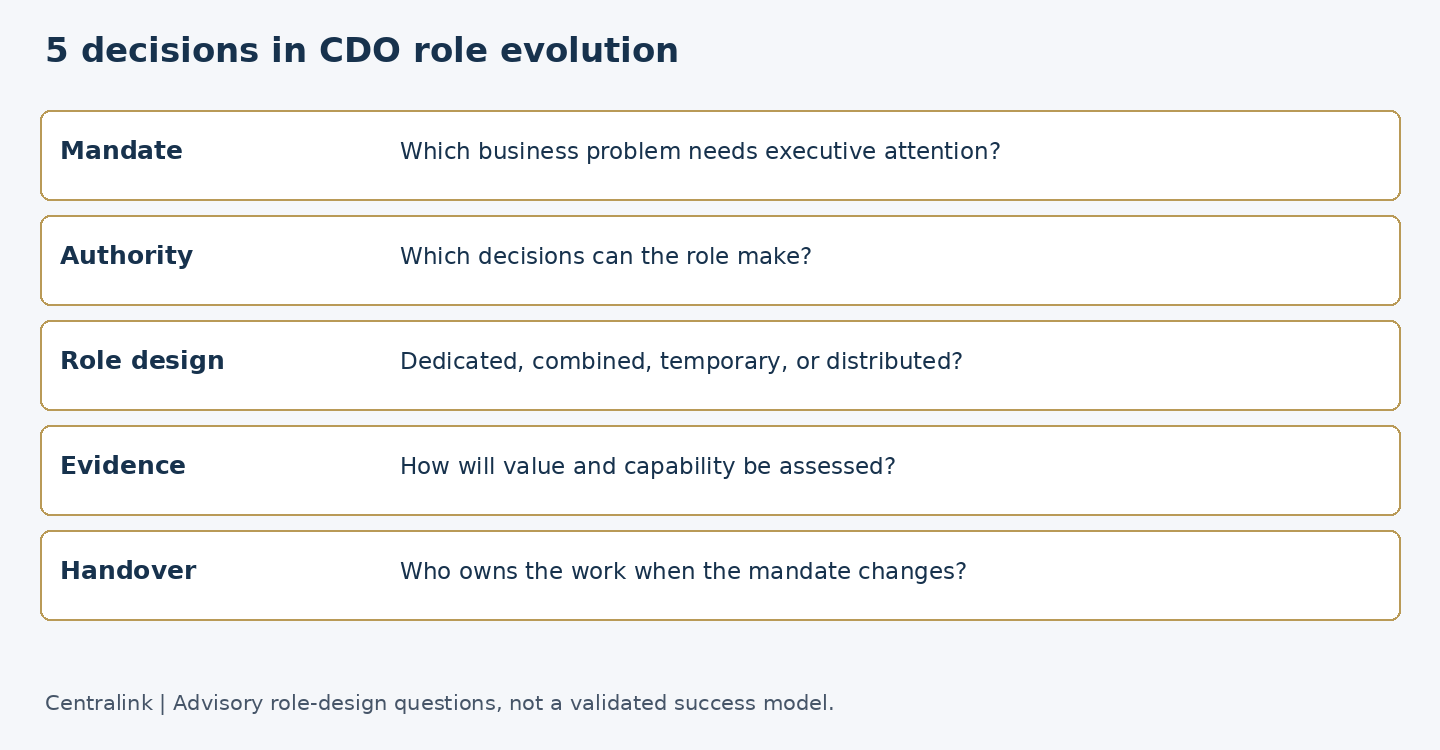
CDO role evolution raises five practical leadership decisions: the mandate, the authority behind it, the role design, evidence of value, and the eventual handover. Here, CDO means Chief Digital Officer, rather than Chief Data Officer.
Table of Contents
What does CDO role evolution mean?
CDO role evolution describes how the remit of a Chief Digital Officer changes as an organisation's digital work develops. The role may begin with a concentrated transformation mandate and later become a coordination, capability, or business-leadership responsibility. There is no single organisational design that every business should adopt.
In this article, CDO means Chief Digital Officer, not Chief Data Officer, which uses the same abbreviation. A digital officer's remit concerns business change supported by digital capabilities. A data officer's remit centres on data responsibilities. Actual job titles can overlap, so organisations should define the work explicitly.
Centralink is a Netherlands-based management consulting and corporate training business. This guide updates its earlier discussion of the CDO's continuing relevance. It focuses on five leadership decisions: mandate, authority, role design, evidence of value, and the eventual handover or renewal of responsibilities.
A 2021 systematic review of Chief Digital Officers describes a continuing debate about appointments, responsibilities, and outcomes. A separate 2024 review in the Journal of Business Research synthesises 29 articles. Together they support examining context rather than assuming that a title alone determines success.
What does the evidence say about the CDO's future?
The evidence does not support a simple conclusion that every organisation needs a CDO or that the role is disappearing everywhere. Studies describe varied remits and organisational arrangements. A useful decision therefore starts with the coordination and leadership problem to be solved, followed by the authority and resources needed to solve it.
N2Growth's October 2026 research reports CDO roles in 129 of the S&P 500 companies, or 25.8%. Of these roles, 46 were standalone and 83 combined digital with another executive function. These figures describe that large-company population, not Dutch SMEs or a universal adoption target.
The same study distinguishes roles created for a defined transformation from roles that continue as digital coordination responsibilities. That distinction is useful for role design, but an observed title distribution does not establish that one arrangement causes better business performance.
For a board or owner, the practical implication is to separate three questions: is there an unresolved leadership problem, does it require concentrated executive attention, and is a new role the best way to provide that attention? Skipping directly to recruitment can leave all three unanswered.

Decision 1: What problem should the CDO be accountable for?
A CDO mandate should identify a business problem and the outcomes the role is expected to help deliver. It should state what the executive owns, what remains with business leaders, and what requires joint decisions. A mandate framed only as making the organisation more digital is too vague to guide accountability.
Describe the customer or operating challenge before listing technologies. The problem might involve inconsistent digital services across business units, an underdeveloped digital offer, or repeated failures to coordinate change. These are hypothetical examples; the organisation needs evidence that its own problem requires this level of leadership attention.
Turn the mandate into a short written agreement. Include the scope, intended outcomes, decision rights, essential partnerships, resources, and review arrangements. Use language that affected executives can interpret consistently. If each leader expects something different from the role, a senior appointment will not resolve the ambiguity.
Also state what the CDO will not own. Operations should not assume that all process change now belongs elsewhere, and business units should not transfer responsibility for commercial results without an explicit decision. Clear boundaries support cooperation because they show where responsibility is shared and where one person must decide.
Decision 3: Should the role be dedicated, combined, or temporary?
A dedicated, combined, or temporary CDO role can each be appropriate when it fits the organisation's problem and capacity. Compare the options by the concentration of work, the need for independent coordination, and the demands on existing executives. Do not select a structure solely because another business uses it.
| Role design | When it may be worth considering | Main question to test |
|---|---|---|
| Dedicated digital officer | A substantial cross-functional mandate needs sustained executive attention | Will the role have the authority and delivery capacity to act? |
| Combined executive remit | Digital work is closely connected to an existing leadership responsibility | Can the incumbent give the work sufficient attention without conflicting incentives? |
| Time-bound transformation role | A defined change has a credible end state and handover plan | Who will own the capabilities and outcomes after the mandate ends? |
| Distributed leadership with one accountable sponsor | Several functions must deliver changes within a clear business direction | Can the governance arrangement resolve cross-functional trade-offs? |
The options are not mutually exclusive across an organisation's lifetime. A business may begin with a time-bound transformation leader and later distribute responsibilities into operations. Another may retain a dedicated role because coordination remains a significant continuing task.
A smaller business should be especially careful about capacity. Adding a title to an already overloaded manager does not create extra time or capability. Equally, appointing a senior executive without a team, budget, or operational support may create responsibility that cannot be discharged.
How should a CDO work with other executives?
A CDO should work with other executives through agreed outcomes and decision rights rather than through a generic claim to own all digital activity. Digital change often involves business, technology, people, finance, and risk responsibilities. Each role needs a clear contribution and a workable method for resolving overlaps.
McKinsey's explainer on digital transformation describes a coordinated leadership responsibility, including the CEO's role in alignment and the contributions of technology, people, finance, and risk leaders. It presents CDOs as potential co-leaders rather than a substitute for the rest of the leadership team.
Treat the CIO and CDO relationship as a practical design issue. The Chief Information Officer may own essential technology services and reliability, while a Chief Digital Officer may coordinate a particular business transformation. These are possible remits, not fixed definitions that override the organisation's agreed structure.
Write down shared decisions that otherwise fall between roles. Examples include sequencing a customer-facing change around core-system constraints, funding capability development, or agreeing when a pilot is ready for operational use. A short decision map is often more useful than an elaborate chart with overlapping accountabilities.
Decision 4: How should CDO value be evaluated?
Evaluate CDO value through the business outcomes, capabilities, and coordination improvements defined in the mandate. Do not treat the number of projects, presentations, or technology partnerships as sufficient evidence. Assessment should distinguish what the role directly controls from outcomes that require the wider organisation to perform.
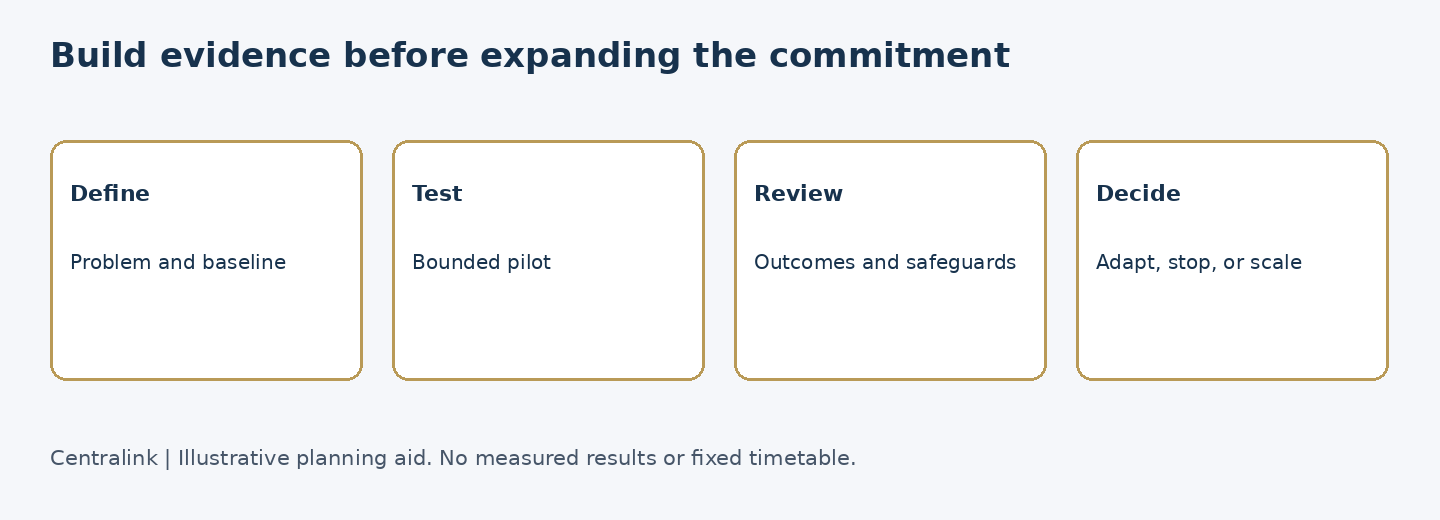
Use a baseline and a small set of clearly defined measures. If the mandate concerns a digital service, evidence might include customer use, service quality, delivery cost, and operational readiness. If it concerns coordination, evidence might include resolved dependencies and more consistent investment decisions.
These are suggested measures, not benchmarks or claims of observed results. Agree how each will be assessed, who will verify it, and what limitations apply. A commercial outcome can be influenced by market conditions and other management decisions, so attribution should be cautious.
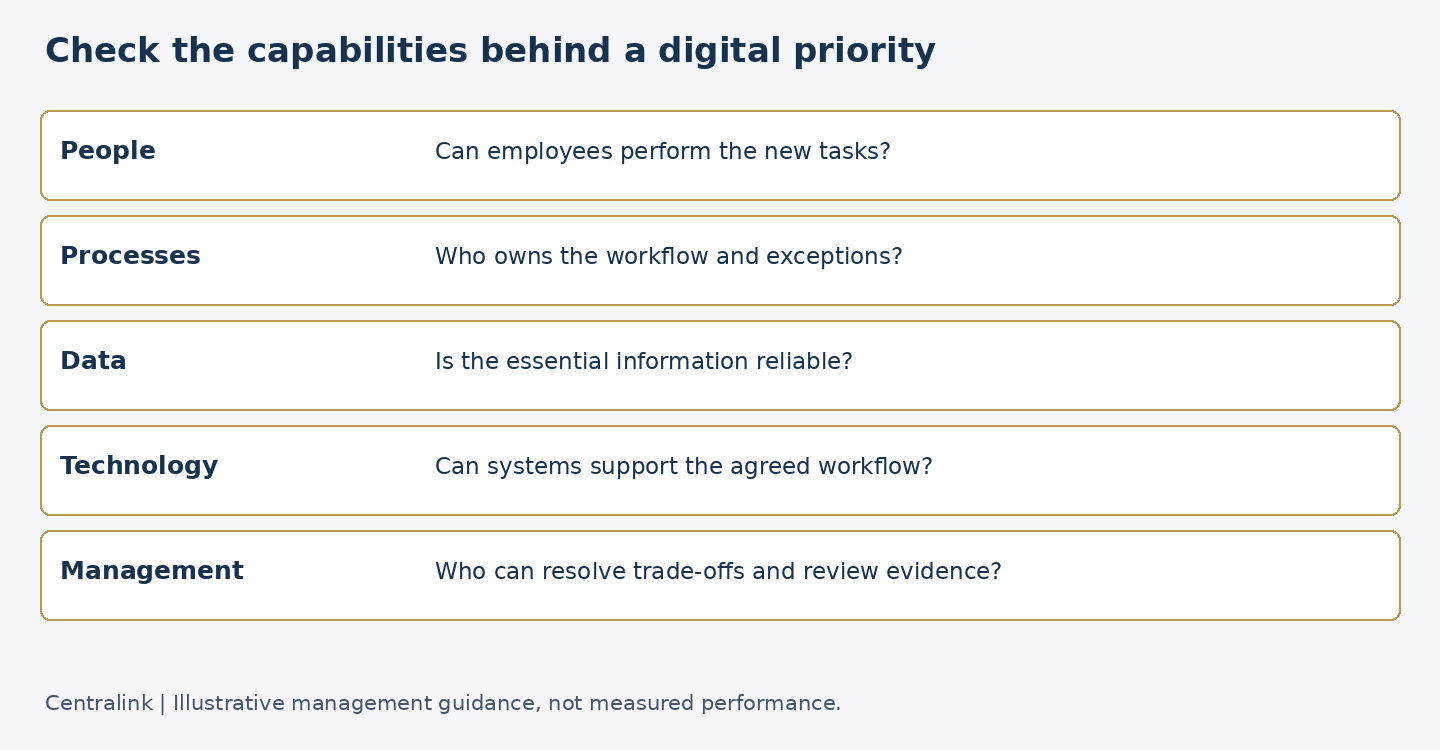
Review the quality of the operating system the role leaves behind. Can business leaders make informed digital decisions? Are process and data responsibilities clear? Can operations support the changed service? Sustainable capability can be more important than a visible launch that continues to depend on exceptional effort.
Decision 5: When should the mandate be renewed or handed over?
Renew or hand over a CDO mandate when evidence about the remaining leadership task supports that decision. A temporary role should have an explicit transition plan, while a continuing role should be reassessed as the organisation changes. Neither permanence nor disappearance should be assumed simply from the original title.
Identify which responsibilities must become part of normal operations. These may include product ownership, service support, data stewardship, workforce learning, and business-case reviews. Name the receiving owners and confirm that they have the authority and resources to maintain the work.
Do not confuse a successful handover with abandoning coordination. Some responsibilities may remain shared and require an executive sponsor or portfolio forum. The handover plan should preserve necessary decisions and safeguards rather than merely remove a position from the organisation chart.
Equally, avoid renewing a role without a clear remaining problem. If the original transformation is complete, ask whether a different remit is needed. A revised mandate should describe the new work and its evidence requirements, rather than retaining the role because it has become familiar.
What should a practical CDO mandate brief contain?
A practical CDO mandate brief should be short enough to use in leadership discussions and specific enough to resolve expectations. It should connect the business problem with decisions, resources, outcomes, and review arrangements. The following structure is Centralink's advisory planning aid, not a validated predictor of appointment success.
- Business problem: Explain the customer, commercial, or operating difficulty and the evidence supporting it.
- Scope: Identify the units, services, processes, and capabilities involved, together with explicit exclusions.
- Authority: State which decisions the role makes, which are shared, and which require escalation.
- Delivery support: Name the teams, owners, resources, and external dependencies needed to act.
- Evidence: Define the baseline, outcome measures, safeguards, and limits of attribution.
- Review and handover: Agree when the mandate will be reassessed and who receives enduring responsibilities.
Test the brief with the executives and managers affected by it. Ask each person to describe what the CDO is responsible for and which decisions remain with them. Differences in interpretation should be resolved before they become delivery conflicts.
Use the brief during recruitment, onboarding, and review. It can help candidates assess whether the role is realistic and help leadership evaluate progress against agreed expectations. It should remain open to revision when the evidence or organisational circumstances change.
What warning signs suggest the role has been poorly designed?
Warning signs include a broad transformation promise without decision rights, repeated disputes over ownership, and a role that depends on personal influence to secure basic delivery support. These signals should prompt a review of the mandate and governance arrangement rather than an automatic conclusion that the individual or title is the problem.
Look for conflicts between the stated mandate and the organisation's incentives. A business unit may be asked to share data or staff while being evaluated only on its own short-term results. Without a leadership decision about that trade-off, the CDO can become a messenger for an unresolved organisational conflict.
Another warning sign is treating every new technology as an expansion of the role. AI, for example, may create new opportunities or risks, but the organisation still needs to decide what business problem is involved and how responsibilities are allocated. Adding a topic to a job description does not resolve accountability.
Finally, examine whether difficult evidence can reach leadership. If every review must present progress positively, the organisation may lose the opportunity to stop an unsuitable initiative or correct the mandate. A useful governance arrangement should make problems discussable and decisions traceable.
How should Dutch SMEs interpret CDO role evolution?
Dutch SMEs should interpret CDO role evolution through their own scale, complexity, and leadership capacity. Research on major listed companies can inform the questions to ask, but it does not establish that smaller businesses need the same executive structure. Start with the work and its dependencies, then decide how to lead it.
A small firm may be able to coordinate a focused digital change through an existing executive and named process owners. A more complex business may need dedicated leadership for a period. In both cases, the decision should make time, authority, capability, and operating support visible.
Use related Centralink guidance on digital strategy priorities and the scale of business change to clarify the mandate before discussing titles. The distinction between an operational improvement and a wider transformation can materially change the leadership requirement.
The result may be a new appointment, a revised remit, a temporary role, or clearer coordination within the existing team. The quality of the decision rests on whether the arrangement addresses the verified problem, not on whether the organisation follows a fashionable structure.
What should leaders do next?
Use the five decisions in this guide to examine the leadership problem before selecting a role design. CDO role evolution is best understood as a change in the work that needs executive attention. A clear mandate, matching authority, and credible delivery support provide a better starting point than the title alone.
Prepare a mandate brief and test it with the leadership team. Identify where responsibility is unclear, where an existing executive lacks capacity, and where a cross-functional decision cannot currently be resolved. Use that evidence to compare a dedicated role with alternative arrangements.
Learn more about Centralink or explore management consulting and corporate training for related organisational and leadership capabilities. Contact the Centralink team to discuss the problem and scope.
Editorial note: This guide combines referenced research with Centralink's independent advisory interpretation. Study populations, dates, and limitations are stated where evidence is used. The role options and mandate brief are planning aids; they are not research findings, appointment guarantees, or claims of client performance.
Frequently asked questions
These answers clarify the scope and practical use of this guide. Apply the guidance to your organisation’s circumstances, and check specialist requirements where the decision involves regulated activities, personal data, or significant contractual commitments. The examples in this article are illustrative rather than reported client results.
What does CDO stand for in this article?
CDO means Chief Digital Officer here. Chief Data Officer uses the same abbreviation, so the full title and actual responsibilities should be stated whenever the distinction could affect a decision.
Is the Chief Digital Officer role disappearing?
There is no universal answer. Some roles are time-bound, some are combined with other executive responsibilities, and some continue with a revised remit; the appropriate design depends on the remaining leadership work.
Does every organisation need a dedicated CDO?
No. An organisation should first establish whether it has a leadership and coordination problem that requires a dedicated executive role. Existing or combined responsibilities can be suitable when authority, capacity, and accountability are clear.
Can a CIO also lead digital transformation?
Yes, if that responsibility fits the agreed remit and the executive has suitable capacity, business support, and decision rights. The allocation should be explicit rather than assumed from the technology-related title.
How should the CDO's success be measured?
Use outcomes and capabilities defined in the mandate, supported by a baseline and realistic attribution. Also assess whether the organisation can sustain the changed service or decision process beyond the executive's direct involvement.