
Currently Empty: € 0,00
AI
AI Governance Gaps: 5 Warning Signs Leaders Can Check
AI Governance Gaps: 5 Warning Signs Leaders Can Check
By Centralink
AI governance gaps appear when real uses, responsibilities, and controls do not match what management believes is in place. Centralink supports management and digital transformation in the Netherlands. This guide explains five practical warning signs and the evidence leaders can examine.
How can AI governance gaps remain hidden?
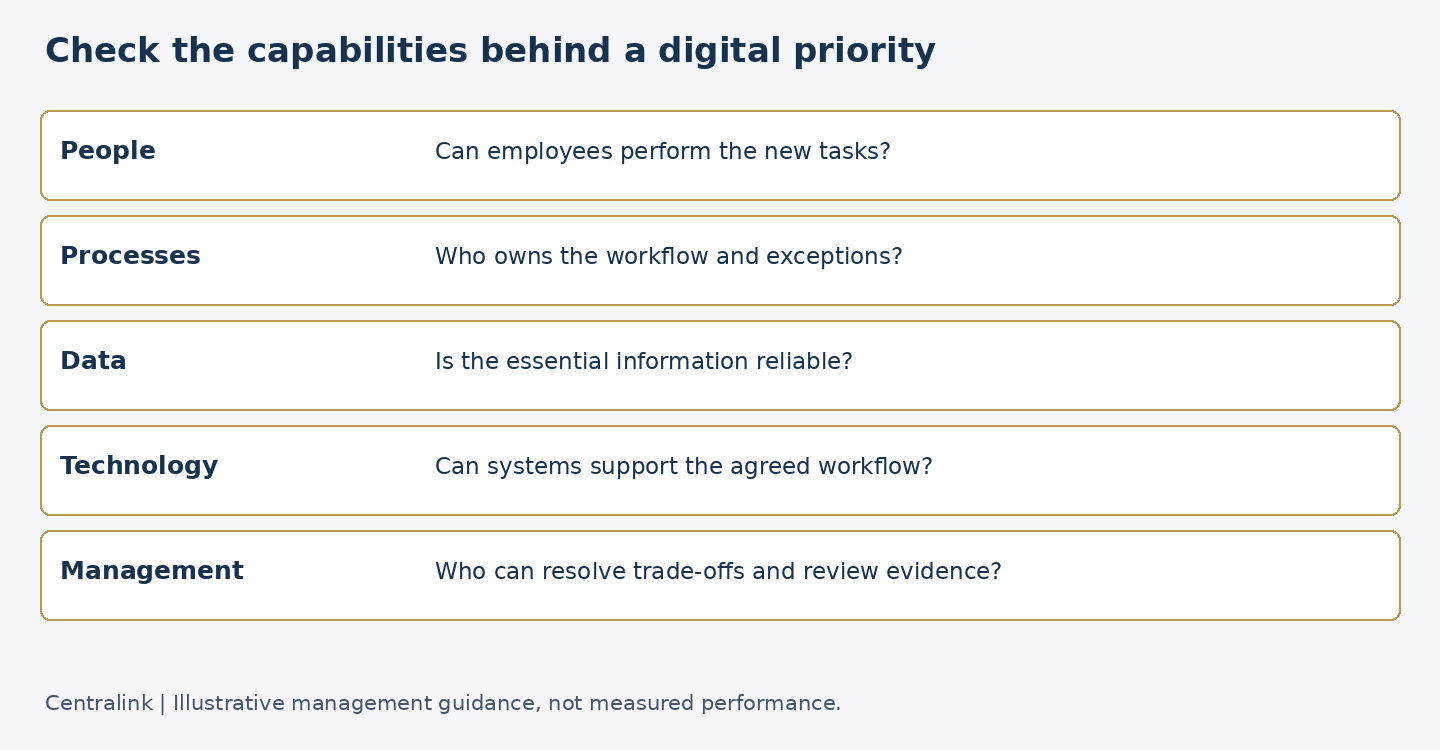
AI governance gaps can remain hidden when a policy exists but operating decisions happen elsewhere. Staff may use unrecorded tools, reviewers may lack time, and business owners may assume a supplier has dealt with every issue. A written framework should therefore be checked against actual work.
Start with a recent task rather than asking only whether the organisation has a policy. Trace the information, output, decisions, and exceptions. The purpose is to understand the gap and its consequences, not to infer failure from one incomplete document.
1. Nobody can describe the actual uses
A warning sign is that management can list approved suppliers but cannot explain which tasks employees perform with them. One service may be used for several purposes with different information and consequences. A supplier register alone does not reveal those operating differences.
Ask teams to identify their uses through a constructive reporting route. Record the purpose, users, owner, input, output, and review. Investigate informal use without assuming that every disclosure proves misconduct.
2. Human review exists only on paper
A review requirement is weak if the reviewer lacks the evidence, expertise, time, or authority needed to challenge the output. The presence of a person in the process does not establish meaningful oversight. Examine what the reviewer actually checks and what happens when they disagree.
Use a realistic example with an error or missing information. Ask the reviewer to explain acceptance, correction, and escalation. If the work cannot be performed under normal conditions, revise the design or scope.
3. Ownership ends when the project closes
AI governance gaps often appear at handover, when nobody accepts ongoing responsibility for monitoring, instructions, support, or supplier changes. A successful launch does not remove those needs. The operating owner must know what to review and when to seek a new decision.
Check the last change or incident. Identify who noticed it, who assessed the consequence, and who could act. If the answer depends on one person’s informal knowledge, make the responsibility and cover arrangements explicit.
4. Metrics reward usage but hide consequences
A dashboard focused only on users, prompts, or speed can overlook factual errors, rework, complaints, and extra checking. Those measures describe activity, not necessarily quality or value. AI governance should connect monitoring with the outcome and the consequences of failure.
Review the difficult cases and the work moved to other teams. Separate serious errors from minor edits. Use the findings to decide whether a control, instruction, learning activity, or use boundary needs to change.
5. There is no workable response to a problem
An organisation needs a route to report an issue, restrict use, investigate consequences, and recover where possible. A broad instruction to contact IT may leave business decisions unresolved. Incident handling needs named responsibilities and appropriate specialist input.
An illustrative service team might discover that outdated information reached a customer. It should know who corrects the information, reviews affected outputs, and decides whether to pause the use. This example is hypothetical and does not establish a particular notification duty.
Evidence and further reading
The NIST AI RMF supports ongoing risk management rather than a one-time launch check. The OECD AI Principles include accountability and transparency. ISACA’s 2025 European survey reports a gap between reported use and formal policy; its sample does not establish the controls or incident causes in an individual company. The five warning signs above are Centralink’s review prompts.
How can Centralink help?
Centralink can help examine an actual workflow, identify ownership and control gaps, and agree practical corrective actions. For the broader structure, read our AI governance guide.
Learn more about Centralink, explore our digital transformation services, or contact Centralink to discuss your organisation’s priorities.
Frequently asked questions
These answers clarify the decisions covered in this guide. Adapt the suggested approach to the organisation’s actual work, people, information, and resources. Examples are illustrative management scenarios rather than reported Centralink client results, and the guidance does not certify a system or establish legal compliance.
Does a missing AI policy prove unsafe use?
It identifies a potential management gap, but it does not establish every fact about the actual controls. Examine the use, responsibilities, instructions, and evidence. Similarly, a policy’s existence does not prove that people can follow it.
Should every governance gap stop all AI use?
The response should reflect the use and consequences. Some issues may justify immediate restriction, while others can be addressed through a controlled improvement. Obtain the relevant specialist input and record who can accept the next decision.
Can a supplier take over all accountability?
Supplier services and commitments matter, but the organisation still needs to understand its own purpose, operating process, people, and decisions. Review the division of responsibilities and applicable requirements. Do not assume a contract or product claim resolves every obligation.