
Currently Empty: € 0,00
AI
SME AI Strategy: 5 Practical Choices That Fit Your Firm

SME AI Strategy: 5 Practical Choices That Fit Your Firm
By Centralink
An SME AI strategy connects selected AI uses with business priorities, available resources, and operating responsibilities. Centralink supports management and digital transformation in the Netherlands. This guide helps smaller firms choose a proportionate approach rather than copy a larger company’s programme.
What should an SME AI strategy decide?
An SME AI strategy should explain which problems deserve attention, why AI may be suitable, and what the business can sustain. It should also identify uses the organisation will defer or avoid. A strategy is a set of choices, not a list of tools or a promise to automate everything.
Size affects budget, specialist access, management capacity, and operating dependencies. It does not remove the need to understand consequences. A small company can still make a significant customer commitment or handle sensitive information.
1. Select a problem within the firm’s capacity
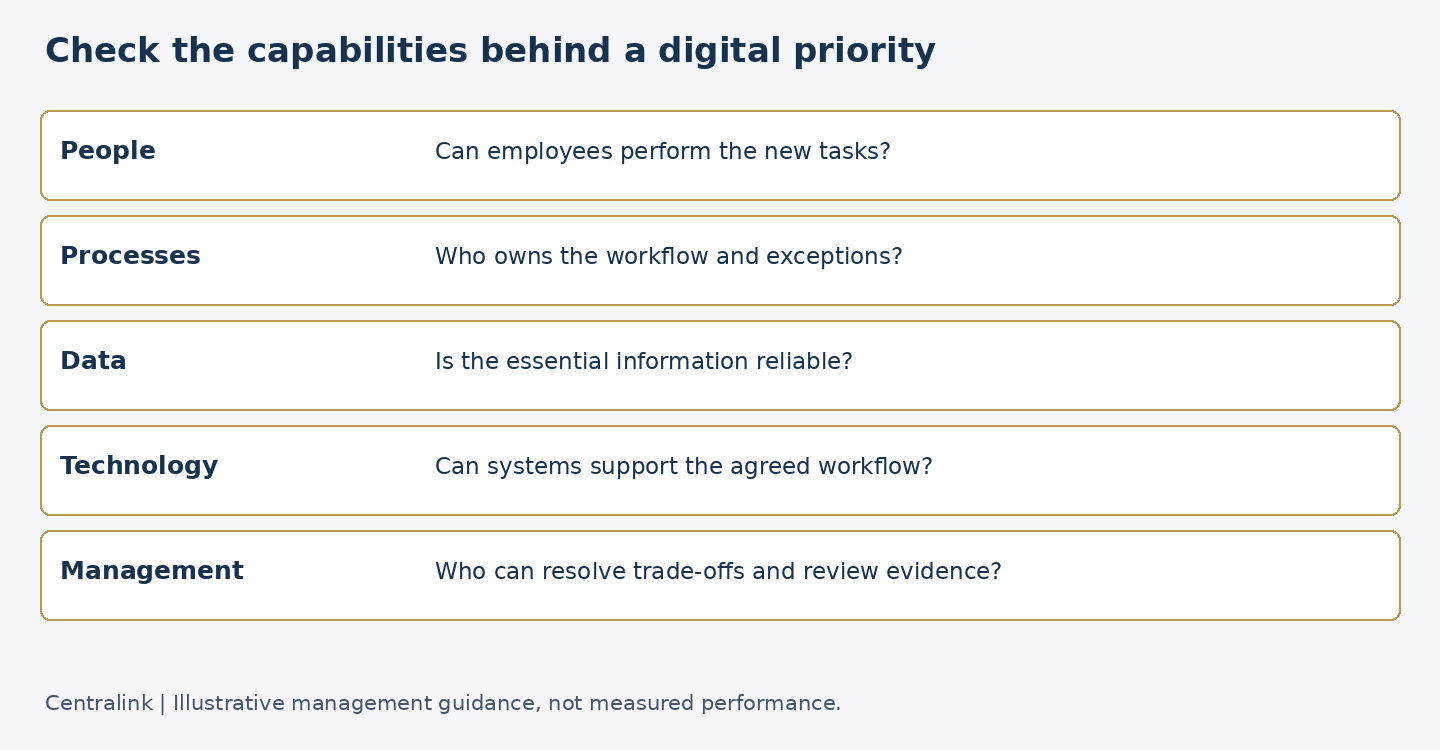
Start with an observable problem whose outcome matters to the business and whose scope can be managed. Compare a process improvement, an existing software feature, and an AI-enabled response. The most technically ambitious option is not automatically the most useful investment.
A hypothetical service business might focus on finding approved internal information before considering an autonomous customer agent. The first choice should reflect actual information quality, review capacity, and the value of solving the problem.
2. Choose the level of customisation carefully
Off-the-shelf tools, configured services, and custom development create different commitments. Compare the fit with the task, total cost, information handling, supplier dependency, and ongoing support. An inexpensive licence can still require substantial operating work, while customisation can create maintenance obligations a small team cannot absorb.
Ask who will evaluate changes, maintain integrations, and support users. Include the ability to retrieve information and change supplier. Choose the simplest arrangement that meets the business need and required controls.
3. Match responsibilities with real authority
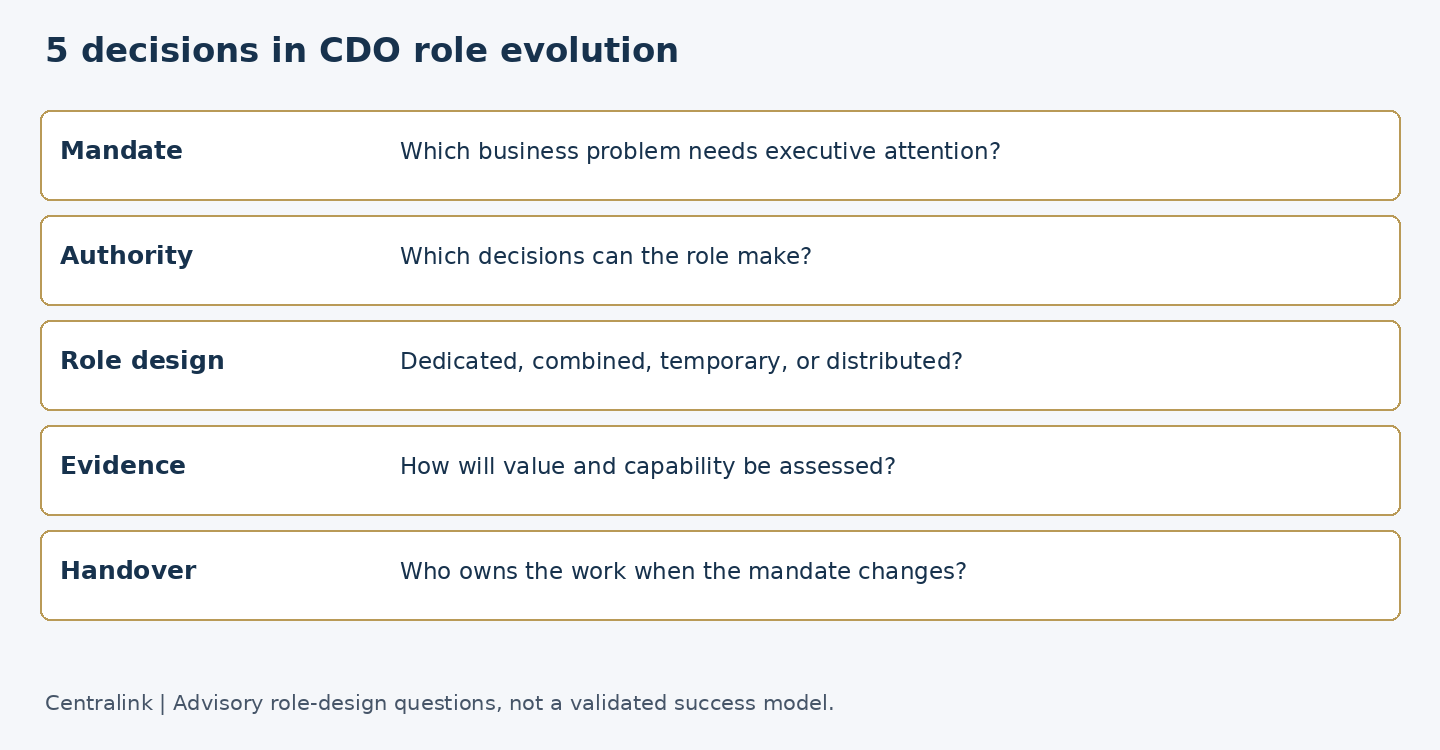
An SME may combine several roles, but the operating responsibilities still need to be explicit. Identify who owns the outcome, approves use, maintains instructions, and responds to problems. Obtain technical and specialist input where the consequences require it rather than assuming a general manager can answer every question.
Use a short decision record. Name the owner, scope, conditions, unresolved issues, and next review. A proportionate structure should make action clearer rather than create a committee that nobody has time to maintain.
4. Budget for use rather than purchase alone
An SME AI strategy should include integration, training, checking, support, evaluation, maintenance, and supplier costs. Explain how the intended benefit becomes usable business value. Time saved is not automatically a cash saving, especially where staff still need to verify the complete output.
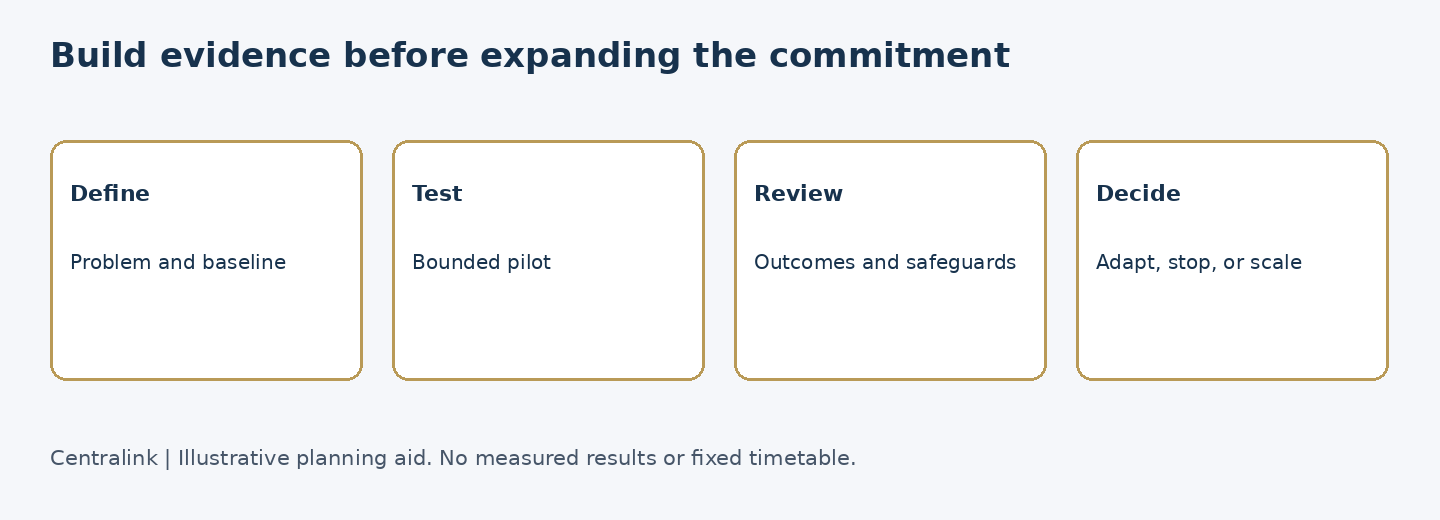
Set a spending and capacity boundary for the first test. Review the result before increasing the commitment. A staged decision protects the firm from treating a small pilot as an unavoidable obligation to scale.
5. Expand only when the evidence supports it
Expansion should follow evidence that the process works under realistic conditions and that the organisation can support the next scope. Review quality, exceptions, correction effort, costs, and customer or staff outcomes. A larger rollout can require new capabilities even when the first team had a good experience.
Connect the decision with the AI readiness review. Document what the test did not establish. A valid strategy can include deciding that a use is unsuitable or less valuable than another improvement.
Evidence and further reading
The OECD’s SME AI adoption paper distinguishes pathways according to digital maturity, use complexity, and application scope. Its 2026 D4SME survey identifies time, costs, and skills as implementation barriers in its non-representative sample. The NIST AI RMF provides voluntary risk-management guidance. These references support proportionate planning rather than one universal programme.
How can Centralink help?
Centralink can help select a practical starting point, compare options, and define the evidence needed for the next commitment. Bring one business problem, its present effects, and the resources the organisation can realistically assign.
Learn more about Centralink, explore our digital transformation services, or contact Centralink to discuss your organisation’s priorities.
Frequently asked questions
These answers clarify the decisions covered in this guide. Adapt the suggested approach to the organisation’s actual work, people, information, and resources. Examples are illustrative management scenarios rather than reported Centralink client results, and the guidance does not certify a system or establish legal compliance.
Does a small firm need a long AI strategy document?
No. A concise record can be useful if it states the priorities, exclusions, responsibilities, resources, and review decisions clearly. Length does not establish strategic quality. Add detail where the decision and consequences require it.
Should SMEs copy enterprise AI programmes?
They can learn from them, but the operating model must fit their own capacity, dependencies, and uses. Avoid buying structures or systems without a clear purpose. Preserve necessary controls while choosing proportionate ways to deliver them.
Is an off-the-shelf tool always the lowest-cost option?
Not necessarily. Include checking, integration, support, information preparation, supplier dependence, and maintenance in the comparison. A low licence price does not establish the lowest total cost or the best fit with the task.