

Currently Empty: € 0,00
AI
AI Adoption Value: 5 Practical Checks Beyond Tool Use

AI Adoption Value: 5 Practical Checks Beyond Tool Use
By Centralink
AI adoption value is the improvement an organisation can demonstrate after accounting for the work, cost, and consequences of using AI. Centralink supports management and digital transformation in the Netherlands. This guide helps leaders evaluate useful outcomes rather than licence counts or enthusiastic demonstrations.
What counts as AI adoption value?
AI adoption value should be connected to a business outcome, such as more dependable service, lower avoidable effort, better quality, or capacity that can be used productively. Tool usage alone does not establish that outcome. A busy dashboard can coexist with additional checking, rework, and customer problems.
Separate adoption, operating performance, and financial value. Each answers a different question: whether people use the process, whether it works well, and whether its benefits justify its costs. A proposal needs to explain the connection between them.
1. Establish the current workflow baseline
A baseline should describe the work before the change, using information relevant to the intended outcome. Record time, quality, errors, demand, handovers, and support where appropriate. Make the sample and its limitations visible so that a later comparison does not rely on an unusually easy starting point.
Use complete tasks rather than only the step the tool accelerates. For an internal report, include collecting information, drafting, checking, correcting, approving, and distributing. A shorter drafting stage may not improve the complete process.
2. Check whether people can use it well
Useful adoption depends on task design, clear responsibilities, suitable information, practice, and access to help. Low usage may signal a poor fit or extra workload rather than reluctance to change. High usage can also conceal inappropriate use outside the tool’s intended scope.
Observe real work and ask staff to show a difficult case. Review what they accept, correct, reject, and escalate. Connect learning with the AI skills gap rather than assuming that a training attendance record establishes competence.
3. Include correction and support effort
AI adoption value should account for the effort required to verify output, correct errors, resolve exceptions, maintain information, and support users. Those activities are part of the service. Excluding them can make a local improvement look larger than the benefit experienced by the organisation.
Identify where the work moves between teams. A draft that saves time for its author may require extra effort from a reviewer. Track serious errors separately from ordinary edits, because a low average correction time can hide an unacceptable consequence.
4. Explain how benefits become usable value
A time saving becomes a business benefit when the organisation can use the released capacity or improve an outcome that matters. Explain the mechanism rather than treating every minute as a cash saving. The same improvement may reduce delay, support more demand, or improve service without reducing expenditure.
Use realistic total costs, including implementation, licences, integration, training, review, support, and maintenance. Distinguish observed results from estimates and show the assumptions that would change the investment decision.
5. Make a decision about the next commitment
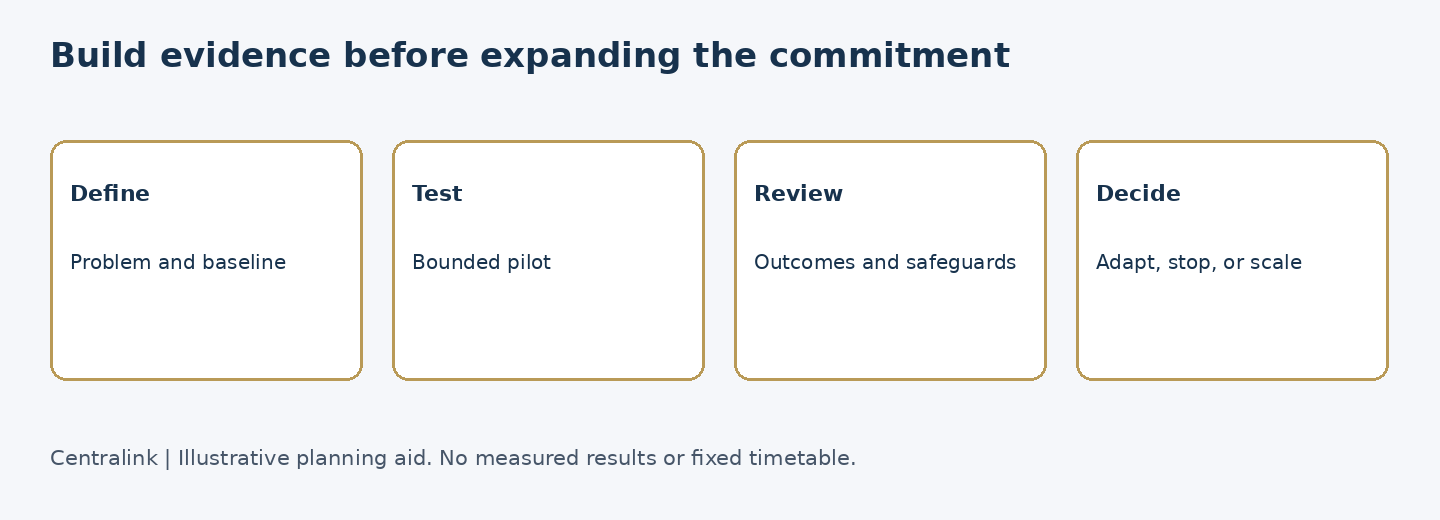
An adoption review should lead to an explicit choice about scope, investment, and operating design. Compare evidence with the acceptance criteria and record the limits of the test. The right decision can be to expand, revise, continue testing, restrict use, or stop.
An illustrative customer-service pilot might show faster first drafts but no improvement in complete resolution time. Management could revise information sources and review steps before expanding. This is a hypothetical evaluation example, not a reported Centralink client result.
Separate usage from business value
Use different measures for different questions and name an owner for each source. A single dashboard number should not stand in for the complete business case. Review important differences between routine and difficult work.
| Question | Example evidence | What it does not prove |
|---|---|---|
| Is it used? | Approved task usage | Quality or benefit |
| Does it work? | Errors and completion quality | Financial return |
| Does it reduce total effort? | End-to-end time and support | Cash saving by itself |
| Is value realised? | Outcome and total cost | Transferability to every workflow |
Evidence and further reading
The OECD’s 2026 D4SME survey reports uneven integration and implementation barriers in a non-representative SME sample. The CIPD’s AI guidance connects technology with people, tasks, structure, and organisational change. The NIST AI RMF supports evaluation and ongoing management. None of these sources establishes a guaranteed return from a particular tool or training programme.
How can Centralink help?
Centralink can help connect an AI initiative with a baseline, an operating review, and a practical investment decision. Start with one workflow where the organisation can observe both the intended benefit and the effort needed to achieve it.
Learn more about Centralink, explore our digital transformation services, or contact Centralink to discuss your organisation’s priorities.
Frequently asked questions
These answers clarify the decisions covered in this guide. Adapt the suggested approach to the organisation’s actual work, people, information, and resources. Examples are illustrative management scenarios rather than reported Centralink client results, and the guidance does not certify a system or establish legal compliance.
Is high AI usage evidence of success?
It shows that a use is occurring, but it does not establish quality, suitability, or value. Review the complete workflow and its effects. Some uses should remain restricted even if employees find them convenient.
Should every time saving be counted as a financial saving?
No. Explain how the capacity will be used or which cost will actually be avoided. Reduced delay or better quality can be valuable without reducing cash expenditure. Keep those benefits distinct in the business case.
What if the pilot shows no value?
Review whether the problem, information, task design, and evaluation were suitable. The result may justify a revision, a simpler response, or stopping. A useful pilot reduces uncertainty even when it does not support expansion.